| Author |
Message |
    
andrew
Moderator
Username: andrew
Post Number: 1017
Registered: 11-2001

| | Posted on Sunday, January 09, 2005 - 10:28 am: | 


|
I have received the following correspondance. Maybe someone here can help. Thanks.
Sent in by Ben Tour:
quote:Hi There
I am kind of "inventor", now in a process of filling a provisional patent for a unique 4 stroke engine. While discussing my approach with a known professional professor, he mentioned the existence of a 2 & 4 stroke marine engines by the name of DOLPHIN.
Would you please be so kind and direct me how to get more information about that Dolphin Engine, May be drawings so I have a chance to understand its principle of operation?
Sincerely
Ben Tour
[email protected]
I responded:
quote:Was Dolphin the name of the manufacture or a particular model name? You will need to supply more info, such as what time period you are referring to.
Ben responded:
quote:Thank you very much for your prompt answer.
The following Internet site describe the professional life of a well known British engine designer. As you can see, one of his engine is called "The Ricardo Dolphin Two Stroke Engine"
http://www.oldengine.org/members/diesel/misc/ricardo.htm
(Shown on page number 2 of 8).
I am looking for any available information about that engine principal of operation, or any other known engine that makes use of more than one cylinder when performing its two or four stroke sequence ( For example the intake and exhaust inside one cylinder while the compression and combustion are preformed inside another cylinder).
Sincerely
Benjamin Tour
|
larry_from_maryland
Senior Member
Username: larry_from_maryland
Post Number: 191
Registered: 07-2003
| | Posted on Sunday, January 09, 2005 - 01:15 pm: |
|
Ben's discription is like the reid oilfield engines which used a small cylinder beside the main one.This cylinder sucked in the gas and air and compressed it.This mixture would then push into the main cylinder when it went down. |
tourh
New member
Username: tourh
Post Number: 1
Registered: 01-2005
| | Posted on Monday, January 10, 2005 - 10:15 am: |
|
Thanks Larry, will try to find and learn about the "reid oilfield engines" and their performances. |
paul_brooking
New member
Username: paul_brooking
Post Number: 33
Registered: 10-2002
| | Posted on Friday, January 21, 2005 - 09:18 am: |
|
There were old two stroke engines that used two cylinders instead of requiring the use of the crankcase. One cylinder was a mixture pump, using an inlet valve operated by atmospheric pressure and a valve in the head of the second combustion cylinder operated by the pump pressure.
The combustion cylinder had the usual exhaust ports.
A completely different realy strange idea I have seen is as follows:
The combustion chamber has the usual exhaust ports, but instead of the usual atmospheric release, the exhaust goes to a water cooled condenser. When the gases are condensed, a small piston pump removes the gas and liquid from the condenser.
because the cylinder gets sucked below atmospheric pressure by the condenser (and also the rapid gass flow at full power), the intake is simply taken straight into the combustion chamber by an atmospheric pressure operated valve in the cylinder head.
I have never seen an example of either these engines, but if anyone intrested, will dig out the manufacturers names.
A valve |
richarddurgee
Senior Member
Username: richarddurgee
Post Number: 704
Registered: 11-2001

| | Posted on Friday, January 21, 2005 - 10:29 am: |
|
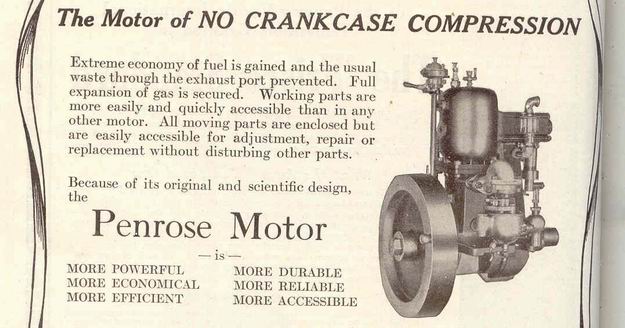
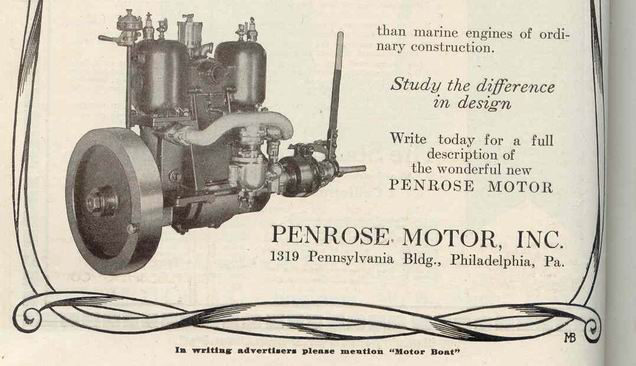
Penrose was one !
 |
tourh
New member
Username: tourh
Post Number: 2
Registered: 01-2005
| | Posted on Friday, January 21, 2005 - 11:24 am: |
|
Paul and Richard. Very interesting and new for me.
I believe soon I will be able to revile and discuss my "may be innovative" Ideas through this fine forum and with you so knowledgeable participant.
Thank you very very much, and any additional information is welcomed
Ben |
paul_brooking
Member
Username: paul_brooking
Post Number: 34
Registered: 10-2002
| | Posted on Monday, January 24, 2005 - 01:16 pm: |
|
Richard do you know what is inside these engines ?
I have been looking at the pictures trying to work it out. I dont think they are like either type I described, the crankcase seems to be used in the usual way. But there seems to be somthing unusual around the exhaust port area.
PAUL |
richarddurgee
Senior Member
Username: richarddurgee
Post Number: 705
Registered: 11-2001
| | Posted on Monday, January 24, 2005 - 02:12 pm: |
|
Paul
I have not been able to find any technical details on this engine as yet. The no pressure crankcase indicates intake and exhaust flow is through the chamber, the twin with a common chamber is very interesting. I try to keep notes and If I find more info I'll post it here. I have always wondered about many of these eng designs as to why they didn't last on the market ??
Good subject |
ben tour
Visitor
| | Posted on Tuesday, December 26, 2006 - 11:24 am: |
|
Hi Guys
About two years ago I have posted a technical question here on your nice site. I got quick and useful responses and for that I am thankful.
Since I felt as engine knowledge and history is part yours guys soul I would be glad to first publicly publish an engine new process I have invented through your site.
I would not like to intrude into an area this forum is not interested in, so please inform me if you agree that I will post here a privet new URL address which present some information about what I believe will become soon the 21 century main internal combustion engine technology.
Sincerely
Ben Tour |
keith
Senior Member
Username: keith
Post Number: 171
Registered: 02-2002
| | Posted on Tuesday, December 26, 2006 - 11:51 pm: |
|
Go for it Ben. Along with our interest in history and the evolution of the internal combustion engine, we would welcome improvements to the technology.
Keith |
tourh
New member
Username: tourh
Post Number: 3
Registered: 01-2005
| | Posted on Wednesday, December 27, 2006 - 01:48 pm: |
|
Is it hope for our piston engine fuel thirsty?
Hi guys.
As probably fits this forum goals, please let me start with some engine history, learn a lesson and proceed by bridging over 250 years into what I believe is going to be proved as one of the more innovative piston engine energy management strategy.
Well,
The period was early 18th century. Few relative primitive steam engines are already around. Probably the most known one is the Newcomen steam engine,
http://www.geocities.com/Athens/Acropolis/6914/nwcmne.htm
The Newcomen steam engine happened to be a very hungry machine. Its enormous appetite for coal severely reduced its popular usage opportunities.
About 50 years later British brilliant engineer James Watt
http://www.geocities.com/Athens/Acropolis/6914/wvae.htm
modified the Newcomen steam engine by implementing two energy saving process modification.
He insulated and heated (using a worm steam jacket) the engine cylinder and he moved the steam condensing function from within the cylinder (as was exercised in the Newcomen engine) down to be placed underground.
Those two modification improved the engine previously very poor efficiency by 350 %. (A fact which directly enabled the industrial era to flourish).
Guys:
Does not our today's combustion engine technology resemble a similar energy wasting process (today we loose intentionally through the cooling systems about 2/3 of the original invested heat energy) ?
Is it possible to thermal insulate our engine cylinders?
Please visit our URL: http://www.tourengine.com
Comments/question are welcomed. |
keith
Senior Member
Username: keith
Post Number: 173
Registered: 02-2002
| | Posted on Wednesday, December 27, 2006 - 04:15 pm: |
|
Have you built a working model?
Keith |
tourh
Member
Username: tourh
Post Number: 4
Registered: 01-2005
| | Posted on Wednesday, December 27, 2006 - 11:14 pm: |
|
Under construction now, will take some more time. |
Stephen Morris
Visitor
| | Posted on Wednesday, June 13, 2007 - 02:44 pm: |
|
Hi, Noticed this request for info on the Ricardo two stroke (not a 4 stroke) there is a sole surviving unit at the office of the firm Ricardo UK Limited. Here is the patent drawing |
tourh
Member
Username: tourh
Post Number: 5
Registered: 01-2005
| | Posted on Thursday, June 14, 2007 - 03:28 am: |
|
Many thanks Stephen and very interesting.
To me it looks like kind of supercharged + two stroke engine. Taking together it become 4 stroke.
I would have loved to read the full patent, is there away to get it through the web?
Thanks again, appriciat the information |
I brockie
Visitor
| | Posted on Monday, July 20, 2009 - 05:49 pm: |
|
The RCA Dolphin engine was a small marine engine, used in small yachtsabout 20 yrs ago. It was a twostroke and did not have a gearbox. I believe that to change from ahead to astern the engine stopped, altered the magneto,and then restarted it. This all happened as you moved the gear lever, and it would restart going the opposite way round |
tourh
Member
Username: tourh
Post Number: 6
Registered: 01-2005
| | Posted on Monday, July 20, 2009 - 11:32 pm: |
|
Got little forward since first mentioning here my thoughts.
Please read
http://www.jpost.com/servlet/Satellite?cid=1246443743936&pagename=JPost%2FJPArti cle%2FPrinter
Or visit www.tourengine.com |
vincent tripodi
Visitor
| | Posted on Sunday, August 30, 2009 - 08:04 am: |
|
to I brockie i have a dolphin engine in my yacht and i am in need of parts perhaps you maybe able to give me some sddresses thank you regards vince |
Dan UK
Visitor
| | Posted on Saturday, June 25, 2011 - 10:08 pm: |
|
Rebuilt and 'as new' dolphin engines with historical info too: http://www.dolphinengines.co.uk/
Dan |
imotorhead
Member
Username: imotorhead
Post Number: 12
Registered: 05-2016
| | Posted on Wednesday, October 19, 2016 - 10:28 pm: |
|
Dan there are 2 kinds of Dolphin engines... the Ricado dolphin uses a piston to charge / scavenge the power cylinder.. The Dolphin you posted a link to is a 2 cyclinder 2 stroke marine engine produced in the 1950's and 60's This may be of interest to you and others... https://www.youtube.com/watch?v=0oG2RSe3P20 |
imotorhead
Member
Username: imotorhead
Post Number: 13
Registered: 05-2016
| | Posted on Thursday, October 20, 2016 - 12:50 am: |
|
Also seems like Ben's engine is an opposed piston split cycle... Clerks first engine compressed in one cylinder and combusted / expanded in another... Here's some video of my extended piston / cylinder split cycle engine running on Diesel fuel. The head on this engine runs at 800f. https://www.youtube.com/watch?v=JzlatGGoxoE |
david_doyle
Senior Member
Username: david_doyle
Post Number: 81
Registered: 03-2013
| | Posted on Thursday, October 20, 2016 - 12:00 pm: |
|
I like boats |
imotorhead
Member
Username: imotorhead
Post Number: 14
Registered: 05-2016
| | Posted on Thursday, October 20, 2016 - 03:30 pm: |
|
The idea of compressing in one cylinder and combusting / expanding in another cylinder is nothing new... Brayton did it in 1872.... Clerk's first engine was a Brayton that he modified for explosion combustion in 1878... Clerk didn't come up with compressing and expanding in the same cylinder until 1880.. He went back in 1886 and made another engine with the split cycle design... https://www.smokstak.com/forum/showthread.php?t=115633&page=20 Several companies have tried to pass this off as a new idea... but it's not ... https://www.youtube.com/watch?v=BK2Mm7TYHuk |
david_doyle
Senior Member
Username: david_doyle
Post Number: 82
Registered: 03-2013
| | Posted on Thursday, October 20, 2016 - 06:12 pm: |
|
Imotorhead:
Thanks for sharing, I really enjoyed learning about this concept especially as it is so applicable to marine applications.
As cooincidence after reading your initial posts I picked up a disgarded publication/thesis from a local tech school and low and behold a GROZ engineer from Austria did his Ph.d on this engine concept in the late 80s (1980s) and it's application to small 2 strokes. Neat stuff.
Hope you keep sharing your builds. tourque and low RPMs are of interest to all here. |
imotorhead
Member
Username: imotorhead
Post Number: 15
Registered: 05-2016
| | Posted on Friday, October 21, 2016 - 10:27 am: |
|
Thanks David, I'm glad you have some interest... I got interested in these types of engines about 15 years ago... I was building some Stirling cycle engines and got interested in Ericsson cycle which led to building the Brayton cycle... which leads to Clerk and the 2 stroke... The Brayton was likely the first practical internal combustion boat motor... Several Brayton motors were installed in boats and operated successfully for many years.. A small Brayton was used to power Holland's Boat #1 in about 1875... In 1881 Holland again chose a Brayton for his Boat #2 also known as the Finian Ram. By 1881 bothe the Otto 4 stroke and the Clerk 2 stroke had been invented yet Holland still chose the Brayton... I believe it had something to do with the high power density... At the time a comparable 15 HP Otto might be 4 times the size and weight of the Brayton.. The double acting engine had a high enough power density to propel the 37' Finian Ram to 9 knots... That's impressive performance even today... It's estimated that the engine in the Ram produced 15-17 HP which if anything seems a bit conservative to me... I can't imagine a 15-20 HP outboard pushing that thing anywhere close to 9 knots... Here is a link to Paul Gray's article in Gas engine magazine. http://www.gasenginemagazine.com/gas-engines/the-fenian-ram
also a good link to more history about the Ricardo Dolphin
http://sias2.pastfinder.org.uk/sih_1970_2008/02-1971.pdf |
david_doyle
Senior Member
Username: david_doyle
Post Number: 83
Registered: 03-2013
| | Posted on Friday, October 21, 2016 - 11:01 am: |
|
" 9 knots... That's impressive performance even today... "
You hit the nail right on the head! That is what really makes these technologies so interesting to me, a combination of the fact that a century (plus) ago these fellows were not producing by any measure an inferior product and they were building with a higher degree of craftsmanship/pride.
measured in simple terms of input (fuel) to output (work) we have not really advanced much. If we throw in longevity and the ability to service engines I'd say we should be embarrassed.
Something signifigant has changed in the way we go about solving problems. If the same level of thought and ingenuity was applied to modern problems as was applied to late 1800s- early 1900s engineering opportunites there would be little left in the way of troubles!
I sometimes suspect that mankinds technological future and fruition must have been left on the fields of Verdun, Flanders etc. We went from making great leaps forward to swinging on branches and eating bannanas.
Thanks for the links I will enjoy them. |
ernie
Senior Member
Username: ernie
Post Number: 2326
Registered: 01-2002
| | Posted on Saturday, October 22, 2016 - 08:53 am: |
|
Don't know how a submarine calculates for hull speed but the displacement hull numbers seem to work.
Displacement hull speed is 1.5 times the square root of its waterline length.
This being said the square root of 37 is is 6.08. 6.8 times 1.5 is 9.10K |
imotorhead
Member
Username: imotorhead
Post Number: 16
Registered: 05-2016
| | Posted on Monday, October 24, 2016 - 12:08 am: |
|
That's interesting Ernie... I found this online calculator... but I think width also plays a part in the calculation... http://www.blueheronwings.com/bh/comps/bdesign.html |
david_doyle
Senior Member
Username: david_doyle
Post Number: 86
Registered: 03-2013
| | Posted on Monday, October 24, 2016 - 12:46 am: |
|
No need for width in the calc for max displacement hull speed.
I do wonder if the 9 knots was submerged or on the surface, IIRC the U-boat that sunk RMS Lisitania had a submerged speed of 9-10 knots.
Anyone know if there is a submariner equivelant of a now wave?} |
imotorhead
Member
Username: imotorhead
Post Number: 17
Registered: 05-2016
| | Posted on Monday, October 24, 2016 - 08:22 am: |
|
If the hull speed calculation is based on the distance between waves what happens when there is no wave? I also wonder about the beam and why it shouldn't matter... would a 40' boat one foot wide go the same speed as a boat 10' wide? What if a 40' boat was 20' or 30' wide? I also thought this was interesting... http://www.extremetech.com/extreme/188752-chinas-supersonic-submarine-which-coul d-go-from-shanghai-to-san-francisco-in-100-minutes-creeps-ever-closer-to-reality
Another link that talks about width... http://www.psychosnail.com/boatspeedcalculator.aspx |
imotorhead
Member
Username: imotorhead
Post Number: 18
Registered: 05-2016
| | Posted on Monday, October 24, 2016 - 10:05 am: |
|
Wave making resistance depends dramatically on the general proportions and shape of the hull: many modern displacement designs can easily exceed their 'hull speed' without planing.
These include hulls with very fine ends, long hulls with relatively narrow beam and wave-piercing designs. Such hull forms are commonly realised by some canoes, competitive rowing boats, catamarans, fast ferries and other commercial, fishing and military vessels based on such concepts.
Vessel weight is also a critical consideration: it affects wave amplitude, and therefore the energy transferred to the wave for a given hull length.
Heavy boats with hulls designed for planing generally cannot exceed hull speed without planing.
Light, narrow boats with hulls not designed for planing can easily exceed hull speed without planing; indeed, once above hull speed, the unfavorable amplification of wave height due to constructive interference diminishes as speed increases. For example, world-class racing kayaks can exceed hull speed by more than 100%,[1] even though they do not plane. Semi-displacement hulls are usually intermediate between these two extremes. |
miro
Senior Member
Username: miro
Post Number: 889
Registered: 11-2001

| | Posted on Wednesday, October 26, 2016 - 08:12 pm: |
|
Weston Farmer's book "From my Old Boat Shop" has an excellent discussion of terminal hull speeds for various hull shapes and the power needed to get them there.
In particular, Figure 2 in Chapter 20 gives the power / speed curves for various hull shapes (length / width)
In any event, it's a great book to have and read over and over.
miro |
Ben Tour
Visitor
| | Posted on Friday, October 28, 2016 - 12:34 pm: |
|
Hello friends,
About 11 years ago I have asked the forum for help in regard to the "Dolphin" Split Cycle engine technology.
Since then I believed and now sure that splitting the IC cycle is a great idea, We spent years in refining practical technology that will enable split cycle engines to deliver efficiency power combined with reduced pollution.
As for today "Tour Engine" is a revolutionary internal combustion split cycle engine with substantial efficiency gain, based on measurements from operating prototypes and state-of- the-art computer simulations.
You are invited to visit : http://tourengine.com/ |
imotorhead
Member
Username: imotorhead
Post Number: 19
Registered: 05-2016
| | Posted on Friday, October 28, 2016 - 01:11 pm: |
|
Hi Ben, Good to meet you here... I started working on split cycle engines about 15 years ago... here is some poor video of my first engine. https://www.youtube.com/watch?v=2cJ4ICyAT4U FYI the Dolphin was not a split cycle engine, it was a piston charged 2 stroke. Brayton was likely the first successful split cycle engine... (constant pressure cycle) then Dugald Clerk modified a Brayton in 1878 with a spark plug and made it an explosion engine (constant volume cycle). Brayton often used extended pistons to allow the expansion cylinder to run hotter but to my knowledge he never extended the cylinder to operate at high temperatures... I have found that a hot running cylinder is really beneficial for having complete combustion. Here's some video of my engine running on diesel fuel. https://www.youtube.com/watch?v=JzlatGGoxoE I'm not sure if you're interested but here is a thread that I started a few years ago... it has a lot of information about the history of this type of engine. https://www.smokstak.com/forum/showthread.php?t=115633&page=19 Also I looked on your site but I'm dissapointed there isn't any video of youe engines running.. Do you have any video or a description of your valve mechanism? |
imotorhead
Member
Username: imotorhead
Post Number: 20
Registered: 05-2016
| | Posted on Friday, October 28, 2016 - 01:14 pm: |
|
Ben I see you have secured quite a lot of funding... I'm not sure of you're interested but I may have some patents that could be helpful... Let me know if you are interested? |
Ben Tour
Visitor
| | Posted on Saturday, October 29, 2016 - 01:46 am: |
|
Hello imotorhead,
Thanks for the feedback.
1. Our site had some "history" engine running clips (under prototypes tongue), soon we will correct this bug.
2. In regard to the valve mechanism, we spent years on finding an elegant solution. As matter of fact, this is part of our technology enabler.
3. Sorry, have not yet read the entire information described in your kind reply.
4. within days will be back releasing more information include wider response to your comments and offers.
Best regard,
Ben Tour |
Ben Tour
Visitor
| | Posted on Saturday, October 29, 2016 - 03:51 pm: |
|
Hi Imotorhead,
Our first prove of concept clip , late 2009.
https://youtu.be/8NQMCZzsckU
Hope you enjoy it,
Best wishes,
Ben |


 Ricardo Patent Drawing


