| Author |
Message |
    
Searcher
Senior Member
Username: searcher
Post Number: 414
Registered: 10-2004
| | Posted on Wednesday, February 10, 2010 - 02:27 pm: | 


|
Can someone provide me with a reference that would indicate the output voltage of a high tension buzz coil (Ford, Detroit, Jefferson, Mesco, etc.) and the output voltage of the low tension coil from the Edison type? |
Paul Gray
Senior Member
Username: paulgray
Post Number: 72
Registered: 05-2003
| | Posted on Wednesday, February 10, 2010 - 07:03 pm: |
|
On the high tension coils, you can figure a turn ratio of 50:1. So for a 12 volt input, you'd get 6000 volts out. The low tension ones I believe it depends on the current and number of turns but I have seen 5-600 volts batted about at peak output. Sparks + Flames book may have some specifics in it. Your mileage will vary considerably with the type of coil and input voltage.... |
Richard A. Day Jr.
Senior Member
Username: richardday
Post Number: 846
Registered: 11-2003

| | Posted on Wednesday, February 10, 2010 - 07:42 pm: |
|
One of the less understood aspects of the Model T Ford coil was the fact every owner quickly learned Henry put a battery in to start but a magneto to run. This gave little point migration and saved a lot of wear on the points as the magneto put out about 16 volt AC and the points hardly moved as the low tension side of the coil was tranformer coupled to the high voltage side to put it in layman's terms. |
Searcher
Senior Member
Username: searcher
Post Number: 416
Registered: 10-2004
| | Posted on Wednesday, February 10, 2010 - 08:36 pm: |
|
Paul, thanks for the information on voltage. |
miro forest
Senior Member
Username: miro
Post Number: 428
Registered: 11-2001

| | Posted on Thursday, February 11, 2010 - 10:11 am: |
|
The voltages vary quite a bit.
Recently I measured 3 different coils.
1) JB's coil using a relay as a trembler
2) the coil I described using a slightly different design for the trembler - The trembler is the mechanism to interrupt the current on the low voltage side of the circuit
3) a traditional Model T type coil where the trembler points is activated by the iron core of the primary coil winding
The results:
1) JB's coil was beyond the scale - so it was over 25,000 volts. The primary DC current was just over 2.1 Amps at 12 V - total power input just over 20 Watts
2) my coil design was about 18,000 volts. The primary DC current was 1.1 Amps at 12 V or slightly less than 15 Watts input power.
3) the traditional coil was about 12,000 volts. The current draw was 0.9 Amps or about 10 Watts input power.
On these old engines, especially when getting them started cold, I have found you need every ounce of oomph at the spark plug to get 'er to fire.
Once the engine is warmed up, it isn't so needed.
On the Model T car, the engine had an in-built alternator on the flywheel which put out about 14-16 volts at 300 to 400 Hz. The alternating current helped prevent the erosion of the points.
For boat engines the simple trick is to reverse the battery connections from time to time.
The remaining question is how long will the charge on the battery last?
Clearly, the more you draw the less time you have to run the engine. At shows, that's not a big problem, but when you're out in a boat, you really want to have enough oomph to get back home.
More on these measurements later.
Miro
ps I think I've figured out why JB's coil is so powerful |
B Millar
New member
Username: bcm
Post Number: 3
Registered: 11-2009
| | Posted on Thursday, February 11, 2010 - 11:20 am: |
|
Historical Information about Ford/KW ignition coils in 3 parts.
Part 1 The Ford/KW Ignition Company Story
http://www.funprojects.com/pdf/The%20Model%20T%20Ignition%20Coil%20-%20Part%201. pdf
Part 2 The Ford Motor and K-W Ignition Companies
http://www.funprojects.com/pdf/The%20Model%20T%20Ignition%20Coil%20-%20Part%202. pdf
Part 3 Chronology of the Ford/KW Coil Unit
http://www.funprojects.com/pdf/The%20Model%20T%20Ignition%20Coil%20-%20Part%203. pdf |
Ernie
Senior Member
Username: ernie
Post Number: 1162
Registered: 01-2002
| | Posted on Thursday, February 11, 2010 - 11:42 am: |
|
I am using a 12 volt 18 amp hour sealed emergency light battery. I charge it every spring and that lasts the whole season |
John Davis
Senior Member
Username: johnny
Post Number: 362
Registered: 03-2006

| | Posted on Sunday, November 07, 2010 - 11:48 am: |
|
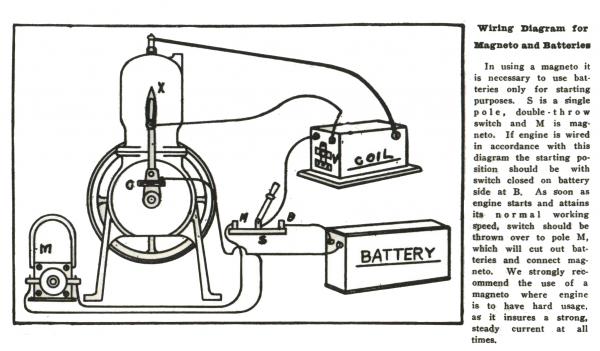
How about something like this for your boat engine. Only uses the battery for starting the engine. Once engine is running you switch it to the magneto. Guess you would have to run the mag with a small belt or friction wheel. Is this really a magneto or a DC generator? I think it is a generator that supplies voltage to the buzz coil. Funny they call it a magneto. This literature is from a Detroit operators manual.
 |
miro forest
Senior Member
Username: miro
Post Number: 522
Registered: 11-2001
| | Posted on Sunday, November 07, 2010 - 01:15 pm: |
|
It is actually an alternator - produces AC at a frequency that varies with engine speed.
This is the set up for the Model T. Start on battery and run on the "magneto".
The voltage also varies with engine speed and can be up to 14 - 15 V.
Running on AC has the benefit that the points in the coil do no erode as much as when they are run on DC.
The bonus to this kind of set up is that the "magneto:" does not have to be synchronized with the piston position, so yes, you could run it with the friction wheel up against the flywheel.
miro |
John Davis
Senior Member
Username: johnny
Post Number: 363
Registered: 03-2006
| | Posted on Sunday, November 07, 2010 - 08:53 pm: |
|
Miro,
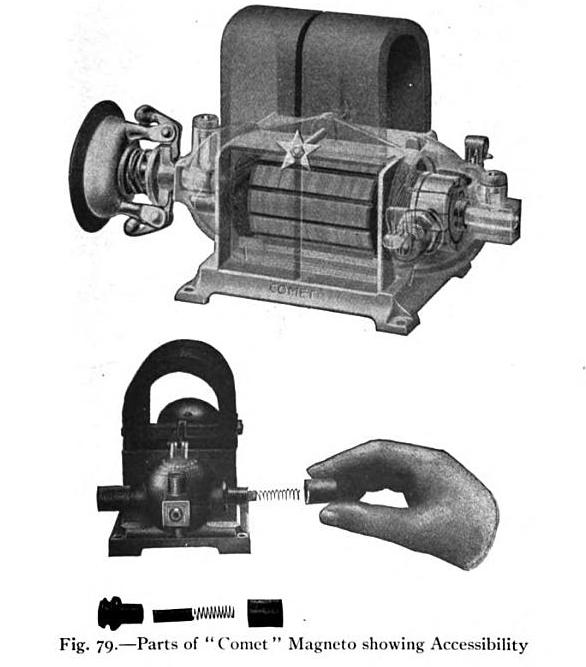
I have seen the huge alternators inside the bell housing on the model T engines. What a pain in the butt they must have been to work on. I new model T's used alternating current. However I did not know the small comet or Wizards were AC voltage. Makes sense that they would be. The magneto in the Detroit wiring diagram above is a Comet magneto with a rubber friction wheel according to the Detroit parts catalog. |
William Schaller
Senior Member
Username: billschaller
Post Number: 358
Registered: 12-2003

| | Posted on Sunday, November 07, 2010 - 09:28 pm: |
|
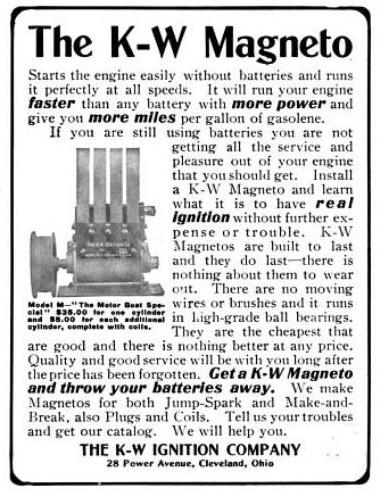
You need the "motor boat special".
 |
William Schaller
Senior Member
Username: billschaller
Post Number: 359
Registered: 12-2003
| | Posted on Sunday, November 07, 2010 - 09:59 pm: |
|
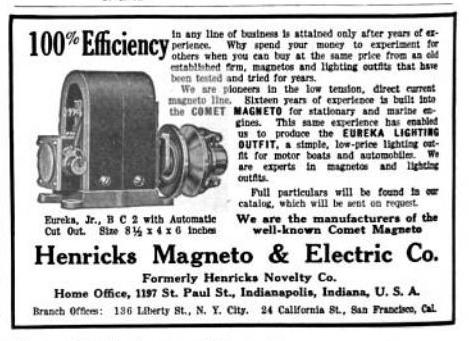
Here is the comet, it has a little governor on the friction drive to regulate speed.
 |
William Schaller
Senior Member
Username: billschaller
Post Number: 360
Registered: 12-2003
| | Posted on Sunday, November 07, 2010 - 10:03 pm: |
|
their ad.
 |
Richard A. Day Jr.
Senior Member
Username: richardday
Post Number: 912
Registered: 11-2003
| | Posted on Monday, November 08, 2010 - 06:49 pm: |
|
Warning there are two basic types of magnetos for early M/B or Jump Spark ignition. The M/B mag wire is much larger than the jump spark wire on the mag armature. I have seen some M/B mags with wire approaching abot 14AWG with the jump spark mags wire nearer 19 AWG. Both types are AC mags. MB high current/low voltage. Jump spark nearer 12 to 16 volt low current. |
Ernie
Senior Member
Username: ernie
Post Number: 1288
Registered: 01-2002
| | Posted on Monday, November 08, 2010 - 08:12 pm: |
|
Old make and break coils have a soft iron core made of many strands of iron wire about 16 awg. They also were NOT made to operate on 12 volts. They draw about 9 amps which is way too much for a set of ignitor points. They were made to operate on 6 volts from dry cells. Also if the engine stops with the points closed with 12 volts things get pretty hot real quick. I use my old coils for display.
The soft iron core helps create a large arc. Just for kicks why don't you try putting some kind of iron core in the center if one of your A/C clutch coils.
Hope this helps
Ernie |
John Archibald
Senior Member
Username: john_archibald
Post Number: 156
Registered: 08-2006

| | Posted on Monday, November 08, 2010 - 09:33 pm: |
|
Ernie,
All my Acadia manuals show 9 volts. You can count the cells in the drawing.
Archibald
Northfield, Minnesota |
fergal butler
New member
Username: fergal_b
Post Number: 2
Registered: 05-2011
| | Posted on Thursday, May 31, 2018 - 06:19 am: |
|
Hi all I have a 1936 service twin it has a 6v battery powered coil, can anyone tell me what make it is or if I cant find one can I use a modern coil to do the same job. Thanks
[URL=http://s753.photobucket.com/user/fergalbutler/media/1936%20OMC%20Elto%20service% 20twin/20180528_135639_zpsf754fkux.jpgoriginal_zpsaeitxbs2.jpeg.html][IMG]http://i753.photobucket.com/albums/xx179/fergalbutler/1936%20OMC%20Elto%20servic e%20twin/20180528_135639_zpsf754fkux.jpgoriginal_zpsaeitxbs2.jpeg[/IMG][/URL] |
miro forest
Senior Member
Username: miro
Post Number: 972
Registered: 11-2001
| | Posted on Thursday, May 31, 2018 - 09:31 pm: |
|
Looking at the picture of your coil there are 3 wires.
One is a ground, the second is low voltage ( primary 6v and timer) and the third is the high voltage to the spark plug.
All of the above is my guess - that's all.
Since it is battery powered, you can substitute a more modern 12V version of a buzz coil. There are lots of sources of the plans to make one up - all you need is a 12V automotive coil, a 12V automotive relay and a 600V, 0.1 or 0.2 mfd capacitor
In the alternative , if it is a 6V automotive type coil and ignition system ( points , distributor etc) , you can still get the those 6V coils - try tractor supplies.
https://www.ebay.com/itm/Ignition-Coil-6-Volt-41-58-Willys-Jeep-Models-X-17247-0 1/381391178997?_trkparms=aid%3D555019%26algo%3DPL.BANDIT%26ao%3D1%26asc%3D201508 17211623%26meid%3D201ff0c4da354674bb2b294a63e839ea%26pid%3D100505%26rk%3D1%26rkt %3D1%26%26itm%3D381391178997&_trksid=p2045573.c100505.m3226
Miro |
Ernie
Senior Member
Username: ernie
Post Number: 2455
Registered: 01-2002
| | Posted on Friday, June 01, 2018 - 05:59 am: |
|
The service twin is a 2 cyl opposed engine. It needs a coil with both ends of the secondary brought out. 1 to each plug. This being the case a normal car coil will not work.
However you can use a coil from an early 90s Mazda Miata and run it on 12 volts.
Hope this helps
Ernie |
Chris Spring
Senior Member
Username: chris_spring
Post Number: 75
Registered: 02-2019
| | Posted on Friday, October 23, 2020 - 07:47 am: |
|
Last year I swithced from 6VDC to 12VDC to power my Ford trembler ignition. Previously the coil had been set to 1.3 amps at 6V. I did nothing other than swap batteries. I am now questioning whether that was all that was required?
What say you?
Cheers! |
miro forest
Senior Member
Username: miro
Post Number: 1103
Registered: 11-2001
| | Posted on Sunday, October 25, 2020 - 07:30 pm: |
|
As long as your engine is running well, - don't mess with it.
Increasing the voltage will increase the current drawn by the primary. That implies that there will be more current going though the timer contacts.
You may find that the points might erode faster .
miro |
Chris Spring
Senior Member
Username: chris_spring
Post Number: 76
Registered: 02-2019
| | Posted on Tuesday, October 27, 2020 - 09:02 am: |
|
I own a total of 5 trembler coils. Two have parts missing. One is complete but un-tested. I bought two that were held out to be tested and set at 1.3 amps. My research says that since these were often powered by a magneto that output 10-30 volts nothing additional is required save for reversing the polarity every now and then to minimize point erosion. Since we are now in the "off" season I think I'll have the three coils tested so I know for certain they are in good shape and that the amperage is correct. The Adams has been giving me trouble lately. It would be helpful to be able to rule out coils.
Cheers! |
Barry Millar
Senior Member
Username: bcm
Post Number: 136
Registered: 11-2009
| | Posted on Tuesday, October 27, 2020 - 03:02 pm: |
|
Chris,
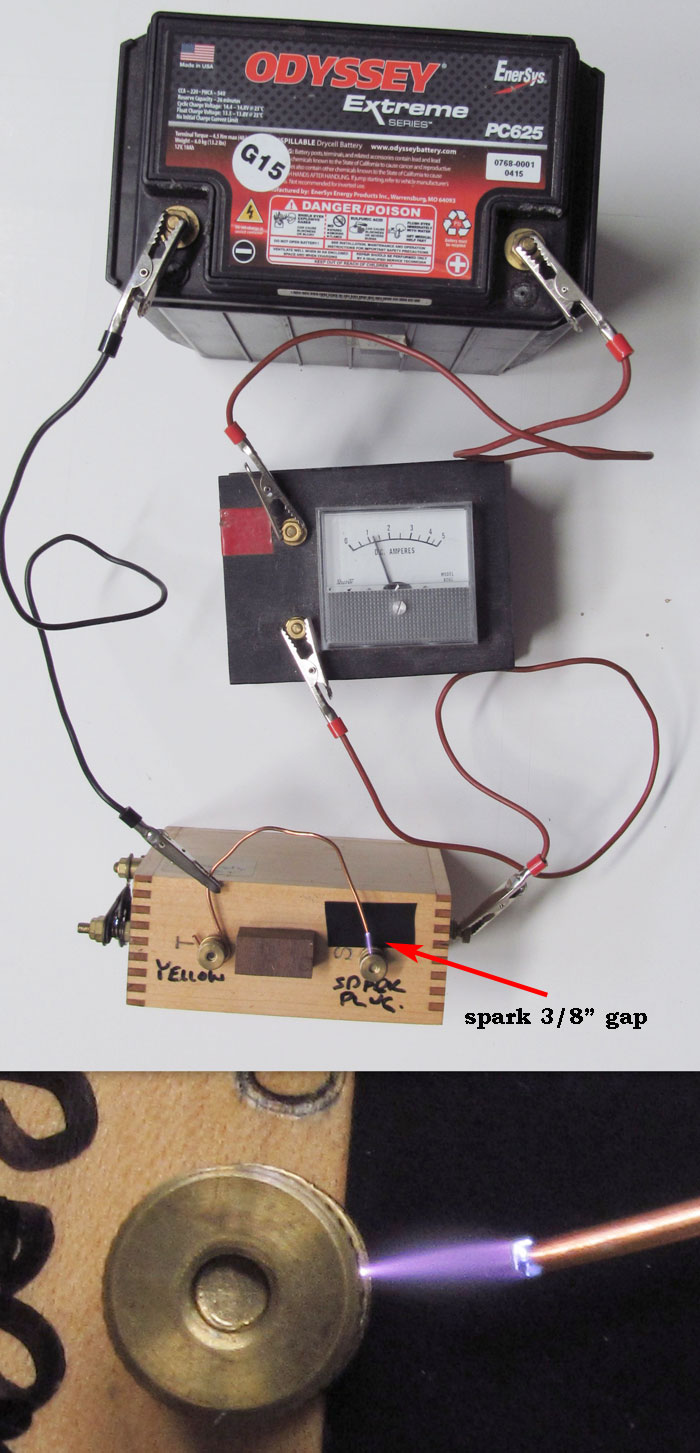
Here is an image illustrating my setup for testing and adjusting buzz coils. You will need a DC analog ammeter available from amazon.ca for $12.
https://www.amazon.ca/uxcell-Analog-Current-Ammeter-Ampere/dp/B0052C9MMI/ref=sr_1_12?crid=23CPXZ2U7K1U9&dchild=1&keywords=dc+analog+ammeter&qid=1603824772&sprefix=dc+anakog+ammeter%2Caps%2C163&sr=8-12
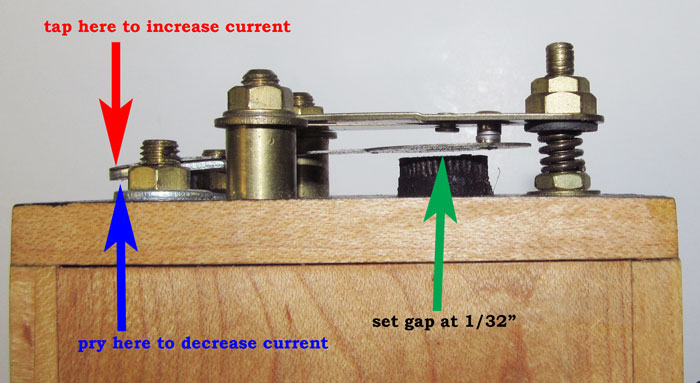
2nd image illustrates method to adjust current.
Recommend you review information sent to you Dec 2018, SUBJECTS 6,7 & 8.
Barry
 |
Chris Spring
Senior Member
Username: chris_spring
Post Number: 77
Registered: 02-2019
| | Posted on Tuesday, October 27, 2020 - 07:16 pm: |
|
Thanks Barry.
Your info is my "go to" I refer to it often.
Cheers! |
miro forest
Senior Member
Username: miro
Post Number: 1104
Registered: 11-2001
| | Posted on Friday, October 30, 2020 - 06:13 pm: |
|
Chris, you'll find that a modern version of the Model T coil ( using the 40 Amp relay and a 12V automotive coil) draws about half of the current compare to the Model T coil, yet gives you a healthier , noisier spark.
It also means that there is less current going though the timer points. I put the modern version onto an "olde" wooden box to make it look nice.
Lately I've tried the coils from a coil-over-plug and they work really well, and are about 1/4 of the physical size of a conventional automotive coil.
BTW the Model T coil is based on a German patent from 1837 by a guy named Rumkorf.
Either version of the coil design makes a very good RF noise transmitter. You'll blot out an AM radio at 100 yards or more. |
Chris Spring
Senior Member
Username: chris_spring
Post Number: 78
Registered: 02-2019
| | Posted on Friday, October 30, 2020 - 08:40 pm: |
|
I found someone locally who has an HCCT and considerable experience dealing with trembler coils. I asked him to test and repair as necessary 3 coils. I only need 1. The other two should provide me and future owners spares. For now I'll stick with trembler coils.
Cheers! |