| Author |
Message |
    
Robert
| | Posted on Tuesday, March 30, 2004 - 01:32 am: | 


|
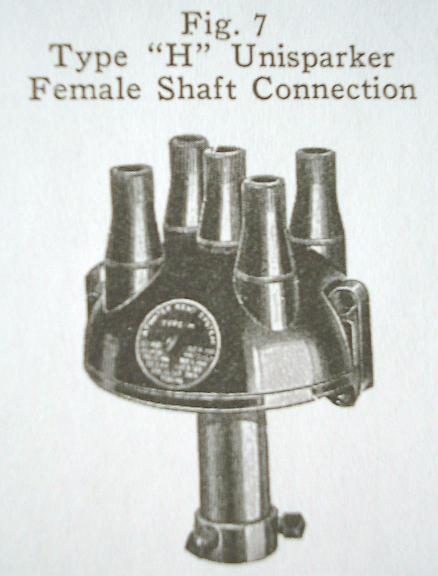
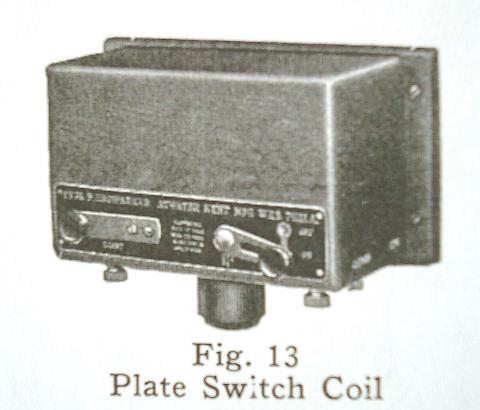
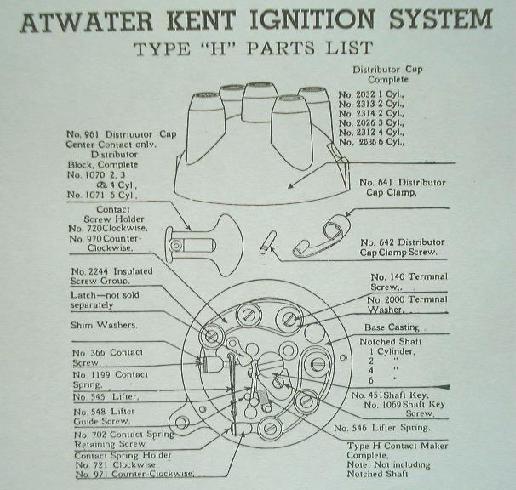
Richard, you are looking for an Atwater Kent Type H Unisparker, otherwise known as "the clicking points" I have a couple of these and some info I will post here FWIW. Atwater Kent went out of business in 1936 when A. Atwater Kent decided to retire to California and closed his operation, at that time the company must have employed thousands. According to what I have read, A. Atwater Kent invented the distributor as we know it and then branched out into radios. The unisparkers are beautifully made and use much less 'juice' than conventional distributors. Apologies to those who already knew all that and perhaps more!
 |
Joe
| | Posted on Tuesday, March 30, 2004 - 02:29 pm: |
|
May I interject to say that I have been advised that the Atwater Kent timer is not uni-directional and must be matched to the engine. Also, the Atwater Kent coil must be used. So Richard, you should specify which direction your engine's timer drive turns. |
richarddurgee
| | Posted on Tuesday, March 30, 2004 - 05:17 pm: |
|
Robert, Thanks for the picture, that is the type of timer/ distributor i am looking for, mine turns clockwise, believe the eng to be 1912-14.
>
Joe, thanks for info also.
>
Dick Days " Palmer Gas Engine Hand Book" has very good info on Atwater-Kent ignition (available on this site in book store).
>
What I don't know is how many different types of timers were used on marine engs , and the actual looks of each, and the different coil boxes that match. I have Atwater-Kent coils with tags that say 1.Type B Unisparker 2. system type K 3. coil to be used only with Type -K2 or H (I know now goes to the one pictured above).these are three I Have, probably other types were made.
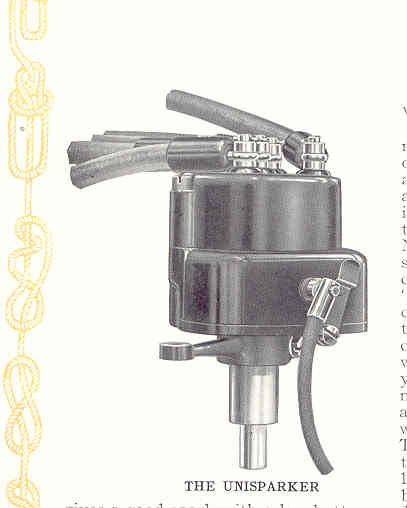
This is a 1909 unisparker from a Roberts eng catalog, it doesn't say what style or type it is ?
 |
Richard Day
| | Posted on Tuesday, March 30, 2004 - 10:33 pm: |
|
Be careful guys. The AW timer is one that you can ruin very easily. Never burnish the points. The points move faster that the naked eye can track so don't be fooled. The coil puts out a spark that can be up to 2 inches long so be careful you don't get tangled up with it. It will really bite!!! This timer will not work with a typical ignition coil and it will not work with a buzz coil. The two wires between the coil and the timer points should be twisted together so they add a small amount of capacitance across the points. The little push button shown on the coil box is used to start the engine. You prime the engine and then hit the push button and very often the engine will start without cranking. The coils are very hard to find and won't work with typical timers so you have to find both the coil and a distributor. The timer will not work on a two stroke where it runs in either direction on the spark. The timers as mentioned above are made for on direction of rotation or the other but not both in the same timer
A bit of history. I understand what happened was the 1930s were the great depression. AW Kent had made a great deal of money in manufacturing and when his people went on strike for more pay he shut the factory fired the help and left town. |
Robert
| | Posted on Tuesday, March 30, 2004 - 11:02 pm: |
|
All those I have seen are counter-clockwise, that is with the bakelite cover removed, the shaft viewed from above, rotates in that direction. Looking at one now, it seems that a clockwise direction would require a different body casting; they cannot be 'reversed' just by reassembly. I had a couple of Type F Unisparkers once, but the one you show Richard, must be even earlier I think. The AK Type H 'guts' were also used on some 1920s Elto outboards I understand and the Type K Unisparker was basically the same mechanism in a different body: one in which the mechanism was mounted on a separate removable plate.

|
Robert
| | Posted on Tuesday, March 30, 2004 - 11:25 pm: |
|
Timed out on that posting attempt. Here we go again:
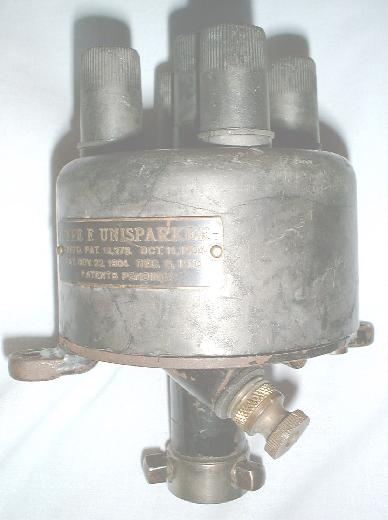
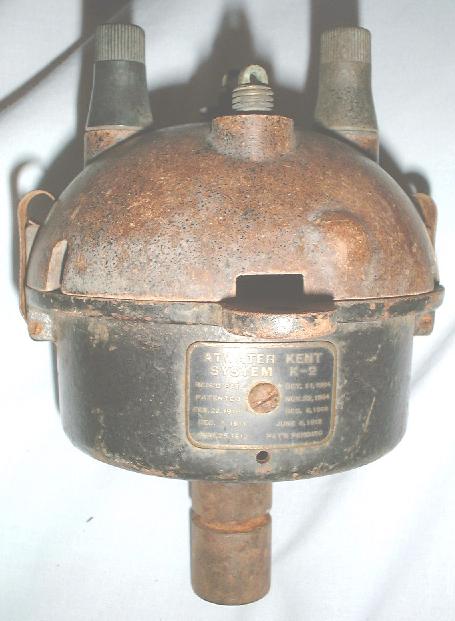
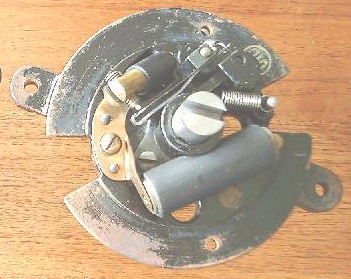 |
Richard Day
| | Posted on Wednesday, March 31, 2004 - 07:34 am: |
|
I forgot to add the operational beauty of the Unisparker was the points are always open except for that momentary closure when the cam causes it to operate. This meant that you couldn't wear your battery down when you left the ignition on by mistake. A set of dry cells could last a whole summer with the Unisparker whereas you needed two sets with a buzz coil that you could reverse polarity to avoid point build up and to give the working cells a rest. |
richarddurgee
| | Posted on Wednesday, March 31, 2004 - 06:48 pm: |
|
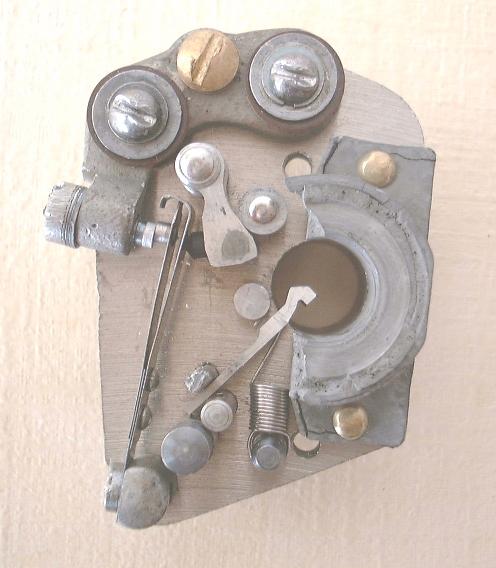
Robert, great pics, the points plate, with condenser is from a true distrubutor and one of the oldest i've seen.
>
Dick, That blue spark , push button start and low battery draw, sounds like an ideal ignition for those days , I wonder why it wasn't used by more mfgrs ??
>
My oldest grandson is in his second year of engineering at Worcester Polytech Institute in Massachusetts the same one that Atwater Kent attended in the late 1800's. the electrical engineering building there is named after him.
The campus story as relayed to me is that AW didn't seem to like to attend classes on a regular basis or do the written work that was assigned,and to top that seems as a prank he took the college presidents favorite horse up into the
steeple tower of the main building of the school and then couldn't get the horse back out again. Took a crane and some deconstruction work to retrieve the stallion !! Aw wasn't invited to attend the college after that. Many years later, and after becoming a very successful industrialist, he donated funds to the school and he was one of the first to recieve an Honorary degree from that institute, class of 1900.
Went on a tour of the campus and the electrical engineering bldg, from the collection of very old machine shop equipment inside the entrance to the hands on labs it definately has a powerful presence of the prior hundred forty years of developing the ideas and machines that set the industrial revolution in motion. reminded me that when the old iron that we are so fond of here on this site passed through these halls it was cutting edge technology, now, but for the few of us involved , the practical application of this knowledge is all but forgotten. |
Richard Day
| | Posted on Wednesday, March 31, 2004 - 09:01 pm: |
|
Richard there was a competitor system made but it slips my mind at the moment. Will try to locate the reference. Seems to me it was about 1912 and called a Delco system. Never seen one except in a book. Now to find that book. Very interesting your comments on AW. One of the stories I heard told of a fantastic estate up in Maine where he held wild parties with very loud music that could be heard for miles as AW had a powerful speaker system long before they were common. |
Robert
| | Posted on Wednesday, March 31, 2004 - 11:10 pm: |
|
Here's the Elto part a gentleman was kind enough to give me...
 |
richarddurgee
| | Posted on Thursday, April 01, 2004 - 12:11 am: |
|
Robert
That reminds me that I have in storage for yrs, an Elto inboard engine, I'll get it out and see if it has this ignition ??
Thats an excellent close up photo ! |
bill schaller
| | Posted on Thursday, April 01, 2004 - 10:28 pm: |
|
I need a 3 cylinder atwater kent distributor cap. This might work to make one.
http://www.5bears.com/casting.htm |
Robert
| | Posted on Sunday, April 04, 2004 - 01:45 am: |
|
Bill, I have a spare three cylinder cap that is a little rough from lying in the bottom of a boat for some decades. Polished up a bit it would probably make an excellent pattern. When you're ready to start let me know and I will send it along...in exchange for one of the new ones ;-) I'll post a few photos tomorrow. |
paulgray
| | Posted on Monday, April 05, 2004 - 09:01 pm: |
|
Anyone have a spare 4 cylinder unisparker distributor (no cap needed)? Harry needs one for the Watkins. Have fodder to trade or buy. |
Robert
| | Posted on Friday, April 09, 2004 - 01:00 pm: |
|
Here's a nice photo of the Type K mechhanism:
http://cgi.ebay.com/ebaymotors/ws/eBayISAPI.dll?ViewItem&item=2470844860&indexURL=4&photoDisplayType=2#ebayphotohosting |
James Crow
| | Posted on Sunday, April 25, 2004 - 11:37 pm: |
|
I have a type B unisparker.
Anyone know how to hook it up??? |
Bill Dickerson
| | Posted on Wednesday, April 28, 2004 - 01:56 pm: |
|
Greetings,
I've been looking for info on Atwater Kent ignition. I have a complete box marked "Atwater Kent System-Type-K", another nearly complete and yet another box marked only "Atwater Kent Mfg. Wks. Phila. PA" and it uses a key (don't have) and has a large lever on it. The lever is marked "Off On" and there is a pushbutton marked "Start".
I have NO clue as to what any of that means. I simply like them. I'd LOVE to get a proper wiring diagram and wonder - could either be used to spark one of my antique single cylinder engines? Some I run on a "buzz coil" and spark plug, others use a simply coil and ignitor system.
ANY help on wiring diagrams, original applications, etc. much appreciated! |
Richard Day
| | Posted on Wednesday, April 28, 2004 - 09:05 pm: |
|
There is a wiring diagram in the Palmer Handbook that Andrew sells. Better read my note above as these coils realy can bite. Don't try to use the coils with any other system than the AW distributor as you will probably ruin an other wise very good and hard to find coil. Pay attention to the polarity and wiring diagram. You can test the coil by wiring it up to a 6 volt battery and arranging a spark gap between the high voltage ouput and ground. Connect the negative of the coil and battery to the ground post. Switch "ON" Then momentarily hit the "Start" button and you should get a spark as much as two inches long on some coils. Start out with say a half inch gap and increase it but don't over due it as you can cause the coil to flash over inside and ruin it. |
jim mcgovern
| | Posted on Thursday, May 20, 2004 - 04:05 pm: |
|
hello - can anyone help me with an atwater kent ignition coil? how can i tell if it is functioning properly? what resistance should i have over the primary & secondary circuits? the coil in question is from a elto ruddertwin. the points etc all look good, and the machine fires weakly once or twice, but will not run. any help would be greatly appreciated. |
pat
New member
Username: pat
Post Number: 1
Registered: 11-2004
| | Posted on Sunday, November 28, 2004 - 06:56 am: |
|
looking for coil diagram for a c-ruddertwin with a atwater-kent i broke a spark plug lead took the coil apart the wires to batt, timer where broken
thanks pat |
Mike in P.S.
Visitor
| | Posted on Tuesday, June 13, 2006 - 01:59 pm: |
|
Can anyone please tell me what this vintage Atwater Kent distributor was for? Thanks for any info. Mike.
http://cgi.ebay.com/ebaymotors/ws/eBayISAPI.dll?ViewItem&rd=1,1&item=4650737054& sspagename=STRK} |
RichardDurgee
Senior Member
Username: richarddurgee
Post Number: 1148
Registered: 11-2001

| | Posted on Wednesday, June 14, 2006 - 01:00 pm: |
|
1912-15 would be a safe guess!
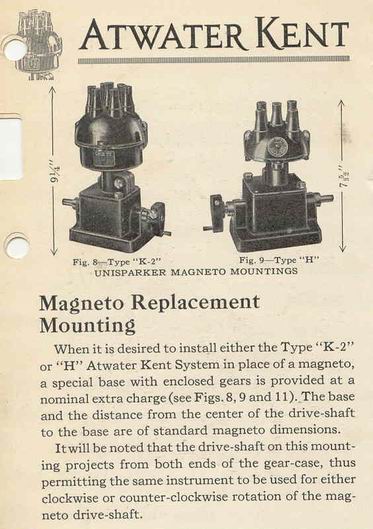
These timers / distributors reguire their own matching coil, the K-2 turns only clockwise, the
H type can be set up to turn in either direction.
The unit on ebay is a magneto replacement for automobiles- could have been used on a marine engine- is was an aftermarket kit !
 |
Robert B. Price
Senior Member
Username: rbprice
Post Number: 206
Registered: 11-2001

| | Posted on Sunday, June 18, 2006 - 10:05 pm: |
|
Hello folks - I have a two cylinder CADY with an Atwater-Kent timer that got smashed during a trip on a trailer. I managed to save most of the timer but the cover was missing some pieces.
I have created a 3D solid model of the exterior of the cover and am working on the insdie contours as time permits.
My intentions are to have a reproduction of the cover made from the 3d model using one of the rapid prototyping processes that create a solid part from liquid polymers. Once that is done, addtional parts could be cast using the silcone rubber mold and epoxy resin techniques. The cast parts would then need to be machined so that the brass contacts could be inserted.
Attached is a PDF file of what I have so far.
Your comments and suggestions are earnestly solicited.
|
Keith Billet
Senior Member
Username: keith
Post Number: 114
Registered: 02-2002
| | Posted on Monday, June 19, 2006 - 11:09 am: |
|
Looking good cap Bob,
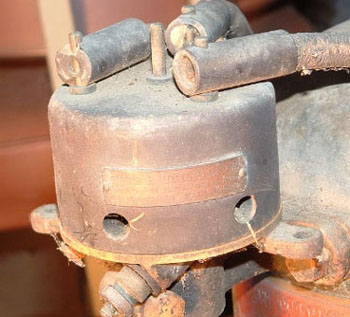
I'm looking for a Atwater-Kent Type B Coil. Any help out there? The picture represents the distributor I am working with.
 |
J.B. Castagnos
Senior Member
Username: jb_castagnos
Post Number: 144
Registered: 07-2002
| | Posted on Monday, June 19, 2006 - 10:18 pm: |
|
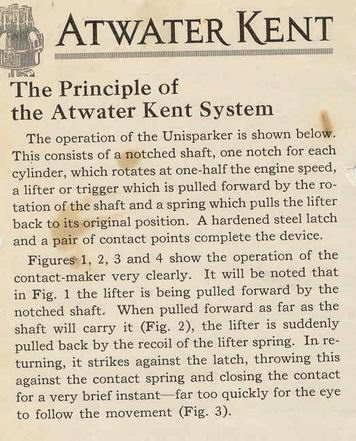
Does anyone have an explanation of the A-K system, from what I see it looks like the latch is a hammer and closes the points by momentum. Whats special about the coil, is it the resistance? Would it be possible to use the distributor to control a Bosch relay, with the points of the relay firing a coil? |
RichardDurgee
Senior Member
Username: richarddurgee
Post Number: 1159
Registered: 11-2001
| | Posted on Monday, June 19, 2006 - 11:55 pm: |
|
JB
This is the best I could find in my stuff !
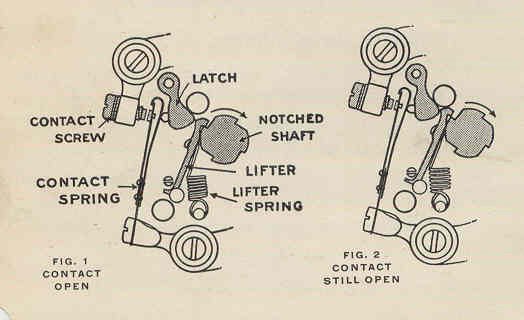
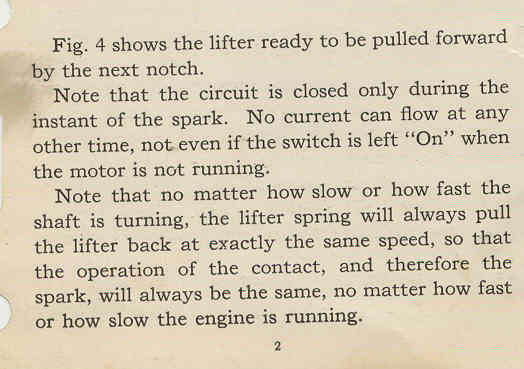
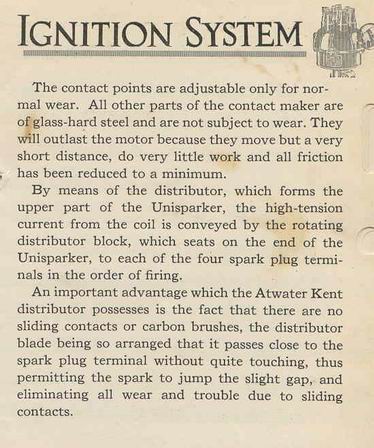
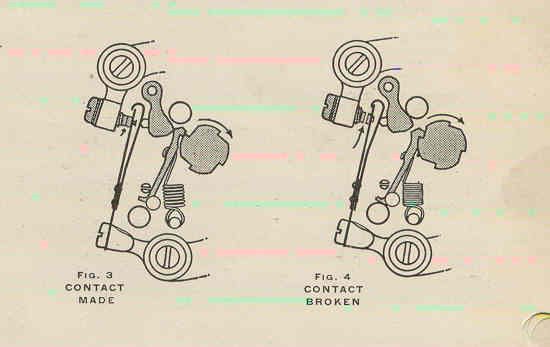
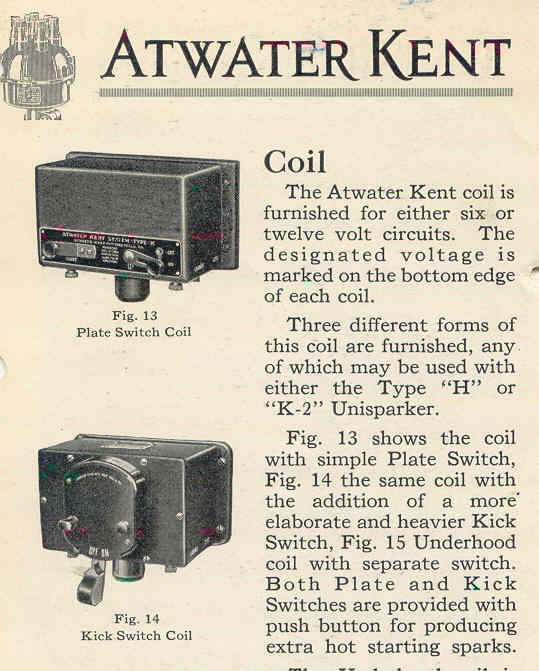
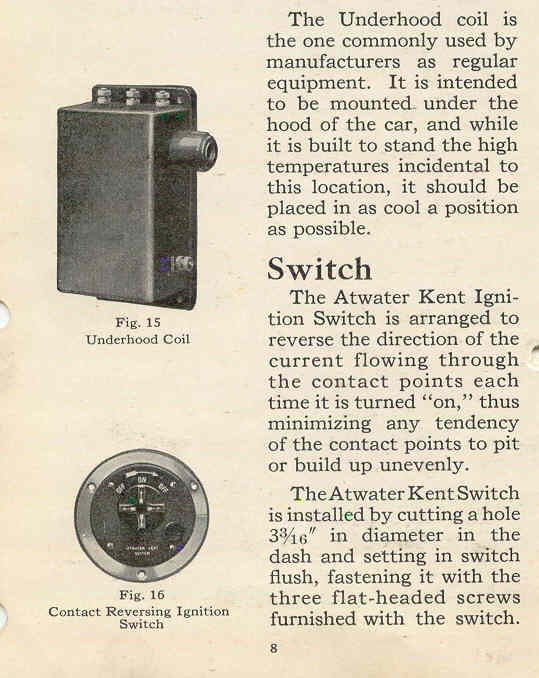
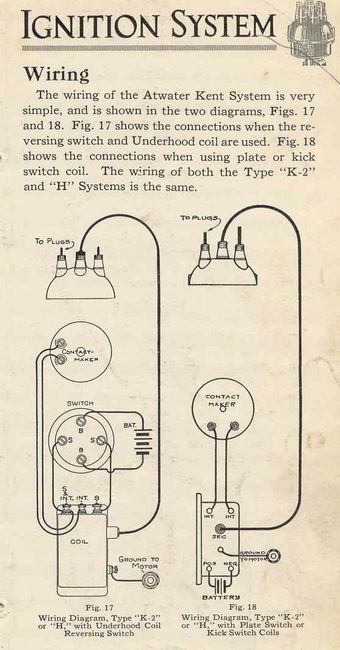
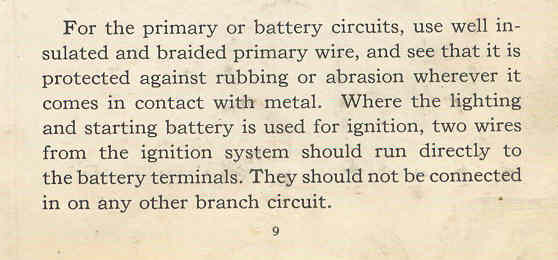
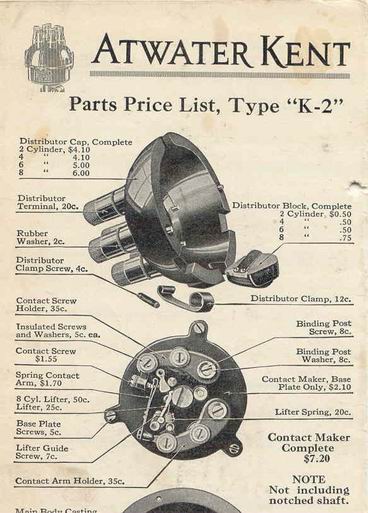
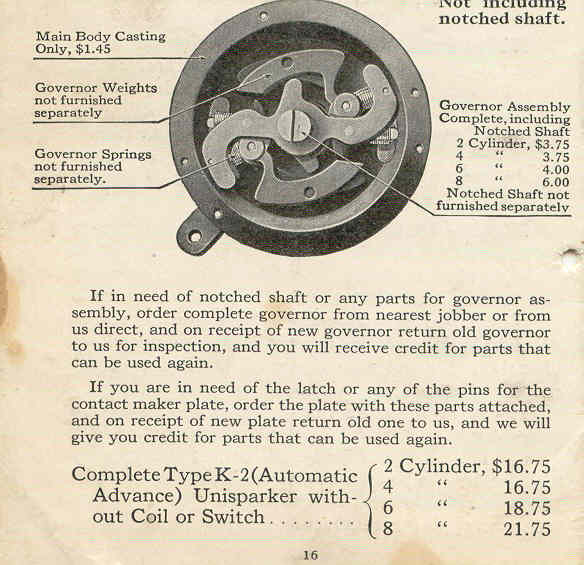 |
J.B. Castagnos
Senior Member
Username: jb_castagnos
Post Number: 145
Registered: 07-2002
| | Posted on Tuesday, June 20, 2006 - 08:17 am: |
|
Thanks Richard, I had an idea how it worked, didn't know the details. |
Richard A. Day Jr.
Senior Member
Username: richardday
Post Number: 341
Registered: 11-2003

| | Posted on Wednesday, June 21, 2006 - 07:47 am: |
|
A photo that may help those attempting to use the AW system. It is really an excellent system for use at shows as the battery consumption is trivial and none when the system is at rest.
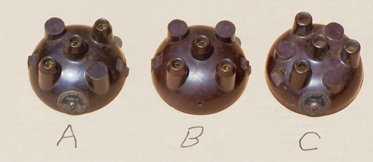 |
Richard A. Day Jr.
Senior Member
Username: richardday
Post Number: 342
Registered: 11-2003
| | Posted on Wednesday, June 21, 2006 - 08:02 am: |
|
I seem to have lost the comments attached to the photos. A is a 2 cylinder cap for either a two sroke or four stroke firing at 180 degrees. B is a 2 cylinder cap for a four stroke firing at 90 degrees. C. is a three cylinder cap for either a two or four stroke. I don't have a 4 or 6 cylinder cap but they look essentially the same.
One must keep in mind that the distributor shaft rotation has to mate with the engine. I do not know if AW ever made a distributor for a two stoke which permitted direct reversing. Would be interested in finding out. My experience with the push button for starting goes back to a 1909 Buick Touring I owned back in 1946. If I choked the engine just as I shut down the engine would almost always start with one "Tickle". A good friend with a Palmer NR-2 rarely has to pull the engine over to start. Just prime and "Tickle" |
Keith Billet
Senior Member
Username: keith
Post Number: 115
Registered: 02-2002
| | Posted on Wednesday, June 21, 2006 - 08:13 am: |
|
Richard Day or Richard Durgee
The above info applies to a Type H or K-2. Do either of you have any info on Type B? |
RichardDurgee
Senior Member
Username: richarddurgee
Post Number: 1163
Registered: 11-2001
| | Posted on Wednesday, June 21, 2006 - 01:55 pm: |
|
Keith
What does the tag on the B timer say, I can't read it ? |
Richard A. Day Jr.
Senior Member
Username: richardday
Post Number: 344
Registered: 11-2003
| | Posted on Wednesday, June 21, 2006 - 07:02 pm: |
|
Richard if you could I would be very surprised it is not there. All about it is the same as the A and C except for the tower number and location. All are type H. |
Robert B. Price
Senior Member
Username: rbprice
Post Number: 208
Registered: 11-2001
| | Posted on Wednesday, June 21, 2006 - 10:12 pm: |
|
Richard Day - the A timer in your picture is what I am trying to reproduce. That artifact could be used to make a silicone rubber mold that then could be used to create replacemet caps. Note that when the part was made, from fiber filled thermo-set phenolic resin using the transfer molding process, inserts were used to create either a two or four cylinder cap. My fragment, like yours, has two closed off plug wire cups. |
Richard A. Day Jr.
Senior Member
Username: richardday
Post Number: 345
Registered: 11-2003
| | Posted on Thursday, June 22, 2006 - 07:24 am: |
|
If you like Bob I will send it to you to see what you can come up with. |
Robert B. Price
Senior Member
Username: rbprice
Post Number: 209
Registered: 11-2001
| | Posted on Thursday, June 22, 2006 - 11:28 am: |
|
That would be great Dick - thanks for the offer.
Robert B. Price
360 Craven Road
Delanson, NY 12053-2139 |
RichardDurgee
Senior Member
Username: richarddurgee
Post Number: 1164
Registered: 11-2001
| | Posted on Thursday, June 22, 2006 - 12:37 pm: |
|
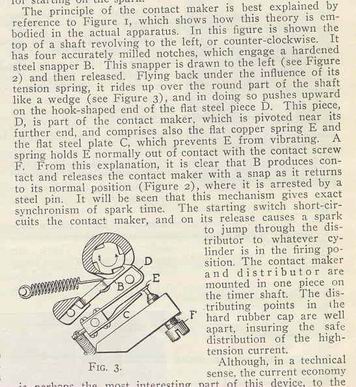
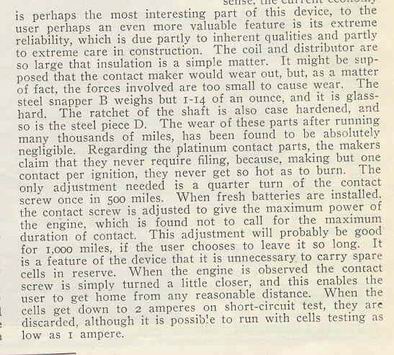
Atwater Kent Ignition
This 1909 article is earliest I can find !
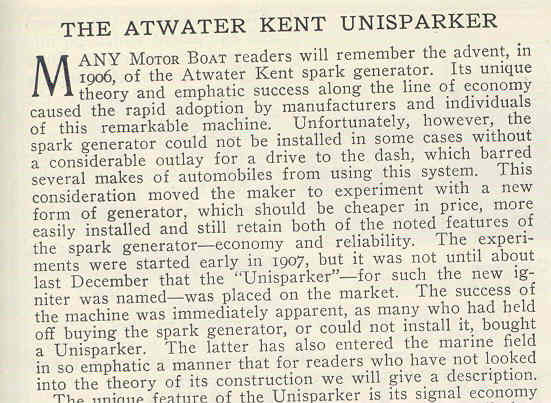
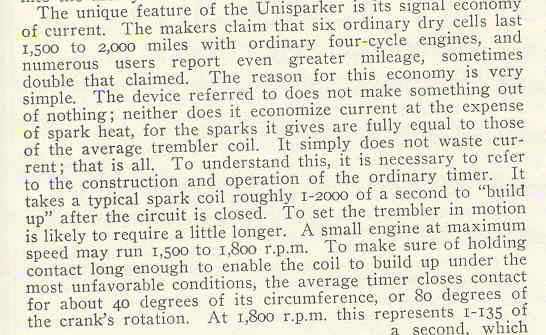
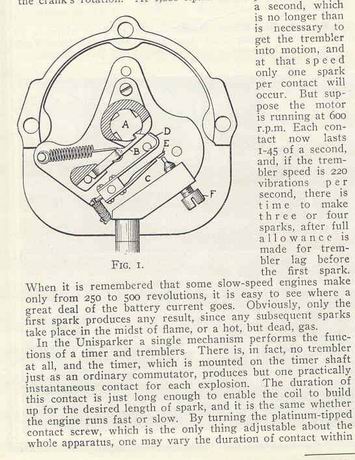
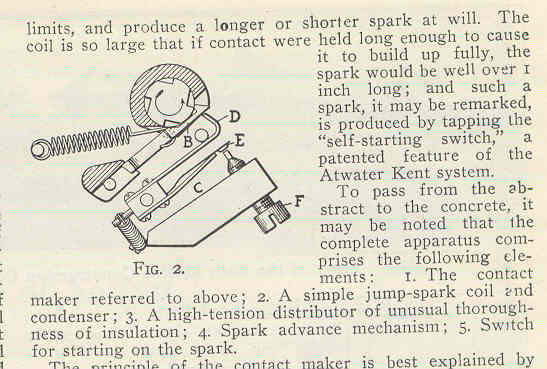
 |
Keith Billet
Senior Member
Username: keith
Post Number: 116
Registered: 02-2002
| | Posted on Thursday, June 22, 2006 - 07:18 pm: |
|
Richard, Some pictures. Notice the pat. date,
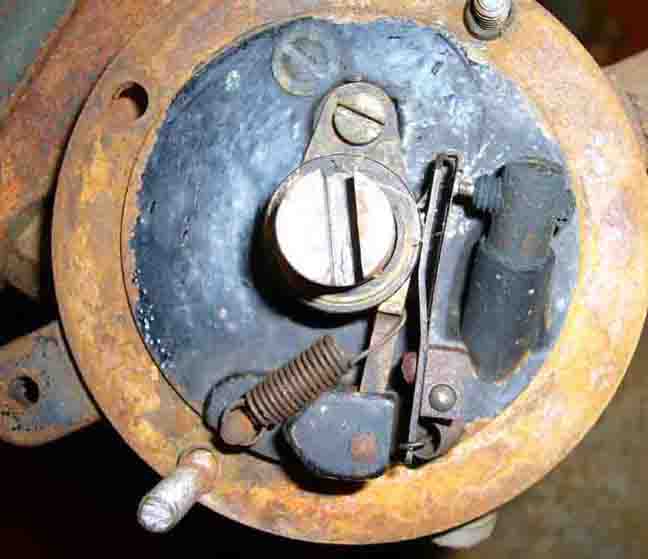
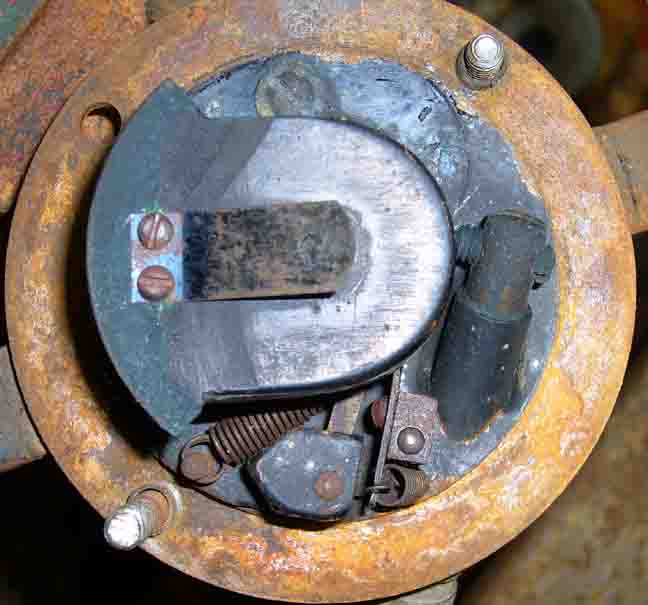
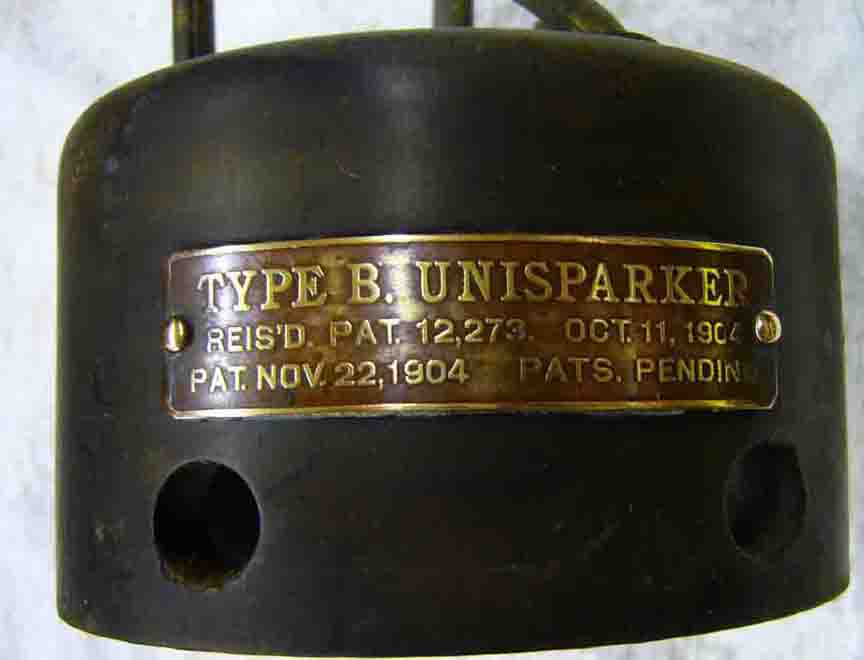 |
Keith Billet
Senior Member
Username: keith
Post Number: 117
Registered: 02-2002
| | Posted on Thursday, June 22, 2006 - 07:45 pm: |
|
This is the motor the Unisparker is on. A VIM rated at 35 to 40 HP. The serial number is three lucky 7's. Note the exhaust flanges for clamping 2" tubing for three individual stacks. It has two 5 Ball Kingstons. The Plug wire with insulation is approximately 1/2" in diameter.
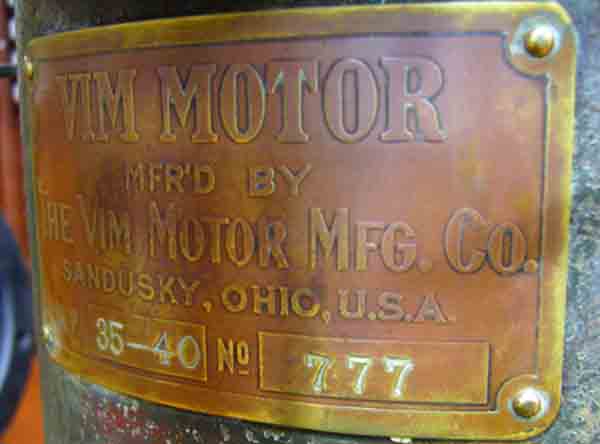
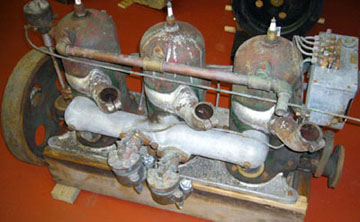 |
RichardDurgee
Senior Member
Username: richarddurgee
Post Number: 1165
Registered: 11-2001
| | Posted on Thursday, June 22, 2006 - 08:58 pm: |
|
Keith
Those really good detailed photos bring about a credibility gap with the above 1907 article, and obviously put the advent of the Unisparker several yrs earlier !
The cam on yours looks the same as the 1907 illustration and the point assembly is similar but still a different design and they are both different than the later K and H Types ??
I have found an Atwater Kent Unisparker Type F in 1909-11 but no detailed schematic of its design yet !
I'll keep looking for more info and post what I find !
The Vim is outstanding and a racing engine of its day with those exhausts, bet that sounds just great sitting next to it at about 800 rpm under load ? |
Keith Billet
Senior Member
Username: keith
Post Number: 118
Registered: 02-2002
| | Posted on Friday, June 23, 2006 - 07:41 pm: |
|
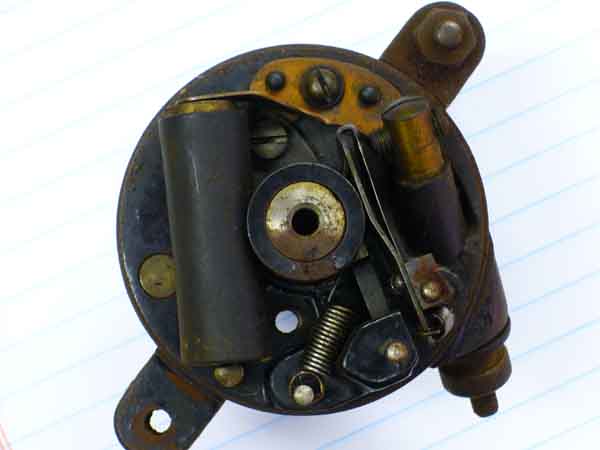
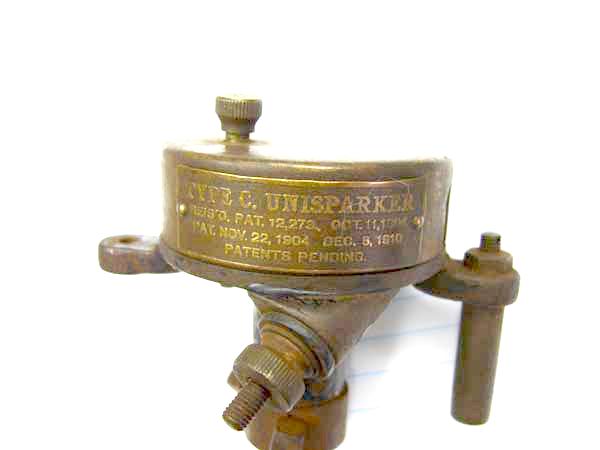
This is a Type "C" Atwater Kent Timer for a single cylinder motor. Last patent date is 1910. What coil does this take?
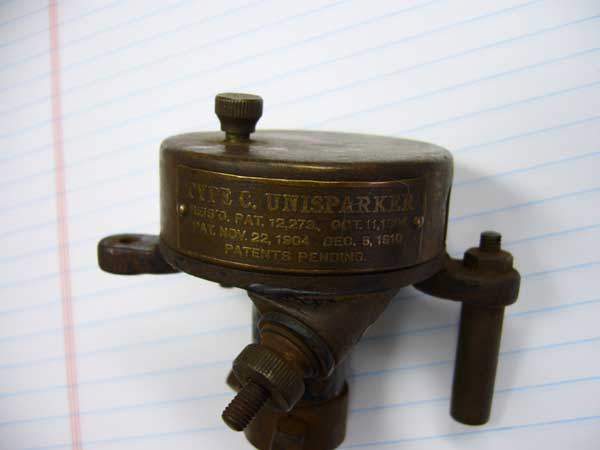
 |
RichardDurgee
Senior Member
Username: richarddurgee
Post Number: 1167
Registered: 11-2001
| | Posted on Friday, June 23, 2006 - 08:59 pm: |
|
Keith
Another Atwater Kent I haven't seen before and more to research, I changed the exposure so we can compare This C type-- looks like B type but now with a condenser added !
Maybe oneday we can find out what coils were used with these old timers ?
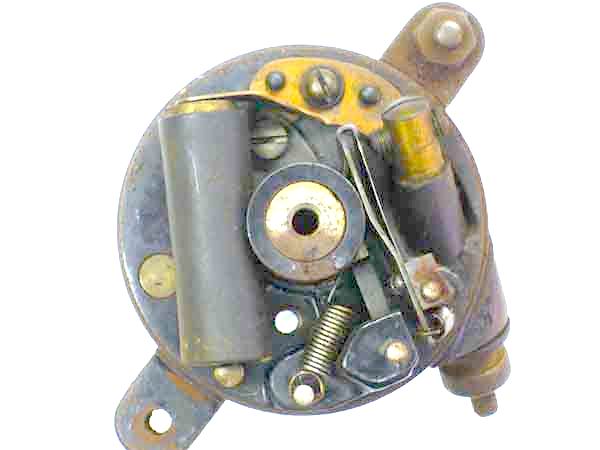
 |
Keith Billet
Senior Member
Username: keith
Post Number: 119
Registered: 02-2002
| | Posted on Sunday, June 25, 2006 - 04:02 pm: |
|
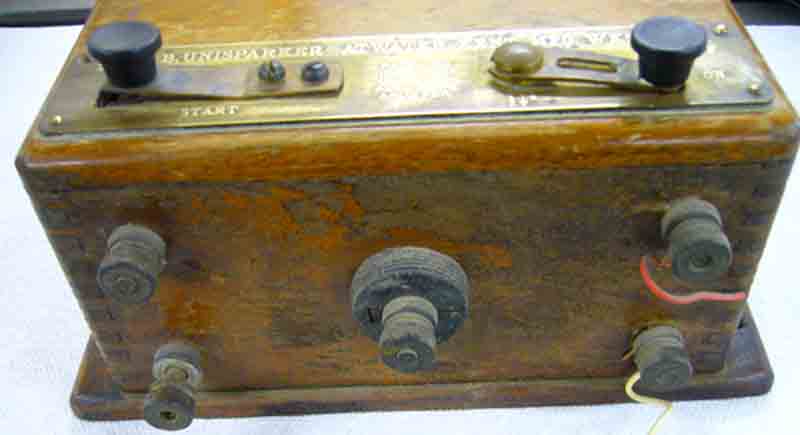
I looked thru my parts today and found a TYPE "B" Coil. Now I just hope its good. The coil has the same 1904 Patent dates. The terminals are not identified. Would like to find some instructions. It has a start button which I presume you would use by priming the engine and positioning the flywheel correctly and then pushing the button. Any help from someone who knows anything about these, would be appreciated.
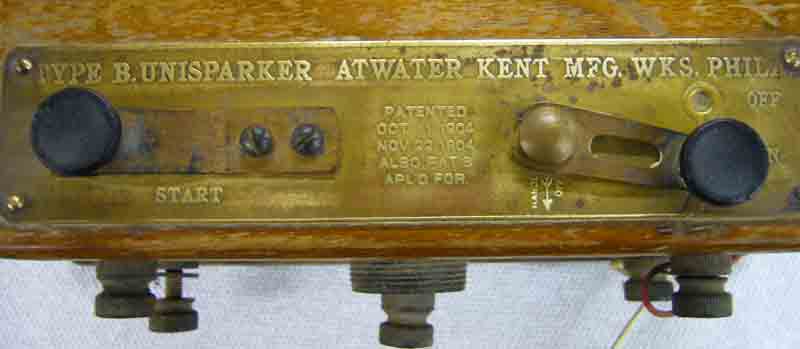 |
RichardDurgee
Senior Member
Username: richarddurgee
Post Number: 1170
Registered: 11-2001
| | Posted on Monday, June 26, 2006 - 05:28 pm: |
|
That's a real find a matching B type coil, 100 + years and it looks in great condition !
Wiring:
The two terminals on right under the on - off switch go to the 6 volt Pos and Neg battery posts, I don't believe the polarity matters and I think it was common practice to reverse these now and again to keep point build up at a minimum !
The center post is high tension spark and goes to center post of timer cap on a muti cyl eng or to spark plug on a single. The coil above is missing a Phenolic cup shaped insulator that threads on the terminal base and covers the connection, but not needed to run it .
The two terminals on the left under the start button should be twisted around each other several times and then go to the timer, one to the insulated point connector and other to a ground .
Not having first hand experience with this starter button maybe Dick Day or Ernie or ? could speak to its actual operation ?
I also have several of these old Atwater Unisparker systems and have not sorted them out and gotten them operational on engines yet so any input would be appreciated ! |
Ernie
Senior Member
Username: ernie
Post Number: 409
Registered: 01-2002
| | Posted on Monday, June 26, 2006 - 06:44 pm: |
|
The start button was like moving the timer on an engine or vehicle that used a buzz coil/s. If the piston was in the corect position in the cylinder with a combustible mixture at least partially compressed the engine would start if the plug sparked. ....maybe...
I have an engine that I just fixed for Dick Day and if you choke it or prime it and then turn the flywheel to just after TDC in the direction you want it to run then move the timer handle so the coil buzzes it will start. With the A K ignition you did the same and then pushed the start button. |
Keith Billet
Senior Member
Username: keith
Post Number: 120
Registered: 02-2002
| | Posted on Tuesday, June 27, 2006 - 08:08 am: |
|
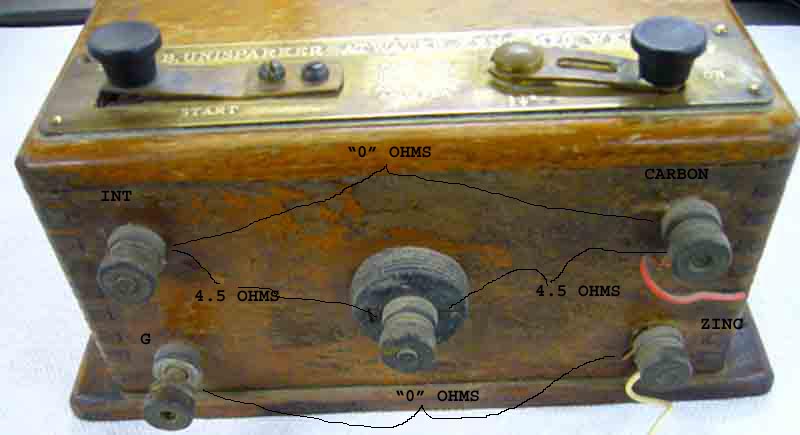
I looked at the coil closer last night. It does have the terminals identified on the sides. Not sure what Carbon and Zinc mean, but they are factory stamps. I'm not an electrician, but I put a ohm meter between the different post and between INT and CARBON there was full continuity. The same between ZINC and G. Between INT and the PLUG post it read about half scale resistance (4.5). The same between CARBON and the PLUG post. There was no reading between INT and G, nor between CARBON and Zinc. Does any of this make sense?
 |
Richard A. Day Jr.
Senior Member
Username: richardday
Post Number: 347
Registered: 11-2003
| | Posted on Tuesday, June 27, 2006 - 09:07 am: |
|
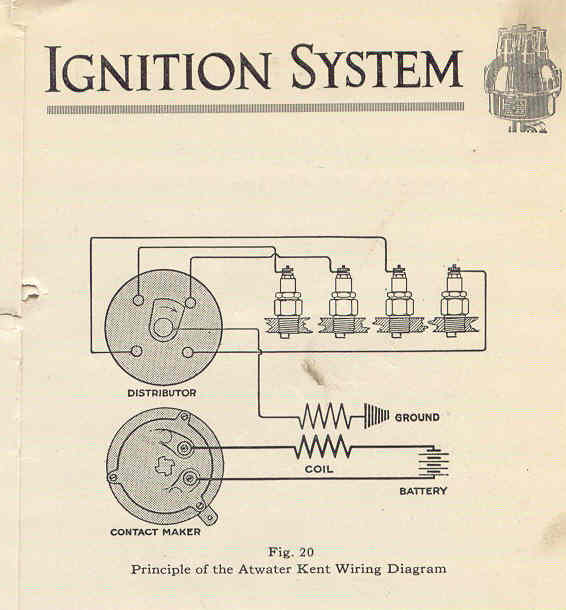
Carbon would be + and zink -. My impression of the design of the system was the current flow across the points was so low that the practice of polarity reversal to avoid point build up was not needed as in Model T buzz coils. The T mageto was about 16 volt AC so it was no problem in the routine operation of the T. I have no explanation for the guide lines that say the leads beteen the interupter and the coil should be twisted together. My assumption is twisting insured a slight amount of capacitance across the contact point circuit with the points opened. Joe Suydam told me no one ever bothered with that in real life. He may be correct but it does not explain why AW thought it important. It should be noted that typical early batterys were often glass jars with carbon and zink elements with a mixture of water and Sal Amoniac. There would be two sets of cells with an ON-OFF_ON switch so these very early cells had a chance to recharge themselve every half hour or so. When the telephone companies started big time production of dry cells then they were widely used in sets of two groups of about 4-6 cells for Jump Spark (5-7 for M/B) with the switch mentioned above. A single set of dry cells would last all summer with an AW coil set up from material I have read over the years. I think it is noteworthy that the AW battery set up was not grounded on either the positive or negative side to the engine. The spark return path was from the ground connection on the the coil. Leave that connection off from the engine and you will find the whole coil battery set up hot to the spark. You won't forget it a second time from my painful expereince. Look at Fig 20 abouve for a great simple diagram of the basic wireing for the AW system.
Your measurements interest me. First question is does the coil put out a good spart when you connect about 6 volts +,- to the battery posts. What I do to check these coils if make a V shapped spark gap using bare copper wire (about number 14 AWG is fine) between the spark output pos and the ground connection Let each leg be about 4" long separated at the bottom about 1/4" and widen out to about 1-1/2" The idea being to provide a spark gap to take the discharge outside the coil as you can destroy it internally operating with no external gap. Turn the coil on and tap the start button. You should get a good spark. Open the smallest gap area and see just how big a spark you can get. I have gotten them as wide as 1-1/2". Don't overdue it. Where was the switch in all this when you made measurements. I think it would have to be ON to read any continuity between the + - and contactor. I would expect the resistance of the contactor ciruit to be very low such as 4/5 ohms with the High voltage circuit between ground and the plug wire in the 10-15k ohms region. I have never understood how AW got such a hot spark with so low dwell time and low current flow. Must be an interesting coil inside. Beyond my pay grade!!! |
RichardDurgee
Senior Member
Username: richarddurgee
Post Number: 1172
Registered: 11-2001
| | Posted on Tuesday, June 27, 2006 - 10:30 am: |
|
Dick
The H and K type coils fig 18 above have 6 terminals with the engine ground to test the spark output to, the B type coil above has 5 terminals - no engine ground,would the procedure to test these coils be to ground the battery - terminal to the engine and test spark to that ground ? That one inch spark in the wrong place would tend to wake me up a little more than I'm used to these days ! |
Richard A. Day Jr.
Senior Member
Username: richardday
Post Number: 348
Registered: 11-2003
| | Posted on Tuesday, June 27, 2006 - 08:33 pm: |
|
I got hit just once Richard and you can bet I won't let that happen again. I missed that point regarding no ground. First measureing reliably below 10 ohms takes a pretty good quality ohmmeter. My guess is that one side of the contactor points must be grounded and therefore the low tension side of the coil is grounded via the shaft driving the contactor. I would assume that by measuring the battery connections you could find which side of the low tension winding is connected to which side the battery + or - is also connected to ground. It goes without saying one side or the other has to be connected to ground on the engine and if the shaft of the contactor is mounted on the engine the timer body would have to be at ground potential. The battery is in series with the contactor and low tension side of the coil hence I guess that says gound is provided via the timer body. Will have to try and see if I can prove this idea. |
Keith Billet
Senior Member
Username: keith
Post Number: 121
Registered: 02-2002
| | Posted on Friday, June 30, 2006 - 11:39 am: |
|
I lucked out with this coil. Last night I hooked a 6 volt 1 amp trickle charger to the coil (didn't have a good 6 volt battery)and made a spark gap between the plug terminal and the "G" terminal, hit the start button and instant spark.
It's not like a buzz coil in that you have a continuous spark as long as there is contact, it's one instantaneous fine blue spark. I tried to take a picture, but couldn't catch it. What kind of gap did they use with the Atwater Kent system? |
RichardDurgee
Senior Member
Username: richarddurgee
Post Number: 1173
Registered: 11-2001
| | Posted on Friday, June 30, 2006 - 10:35 pm: |
|
Keith
100 + years old and still works ! Good stuff
Thanks Dick for your wisdom here!
After this discussion I'm going to have to proclaim an Atwater Kent day and dig all my coils and timers out and see what I have and what works!
Thanks Richard |
Tyler Bond
New member
Username: tbond
Post Number: 2
Registered: 07-2007
| | Posted on Sunday, July 15, 2007 - 08:33 pm: |
|
I have a Ford Model T and i am looking for Atwater-Kent Type LA Distibutor Points if anyone knows where i can purchase these at it would be greatly appreciated. |
Todd Manoff
Visitor
| | Posted on Thursday, October 11, 2007 - 06:26 pm: |
|
Hello,
I have a Atwater kent type F unisparker dist that is mounted on a 2 cyl Universal Machinery Co. engine. I am in need of the rotor for the type F unisparker unit if anyone would have one available. I also have a question, would a A-K type F ignition coil box be needed for the Type F unisparker dist, or can another type coil box, say, type B or H ect be used instead?
Thanks so much for any help.
Best regards,
Todd Manoff |
Todd Manoff
Visitor
| | Posted on Friday, October 12, 2007 - 01:37 pm: |
|
I just discovered last night with the helpful information on this site that my Type F unisparker distributor also appears to be missing the Snapper arm. I would be interested in any info, parts (Rotor, Snapper arm, snapper spring, bakelight insulators that screw on cap) The Type F distributor is mounted on a Universal Machinery engine in my 1913 Zip cyclecar. Thanks in advance.todd |
Robert
Senior Member
Username: robert
Post Number: 179
Registered: 07-2003
| | Posted on Tuesday, October 16, 2007 - 12:32 pm: |
|
I have some rather rough contact covers (insulators) for a Type F, if you need some. |
Richard A. Day Jr.
Senior Member
Username: richardday
Post Number: 525
Registered: 11-2003
| | Posted on Tuesday, October 16, 2007 - 10:33 pm: |
|
One of the problems tungsten contacts suffer from is at DC voltages lower than about 20 volts they tend to build up a resistance to current flow. The reason the typical 6 or 12 volt tungstan contacts work reliably is there is a relativly heavy current flow across the points and the inductive kick when the points open causes the voltage across the points to rise sufficiently high so the points don't build up the surface resistance to 6 or 12 volts. In the AW Kent system the current flow across the points is a tiny fraction of the classic distributor current. Therefore there is little tungsten migration from one point to the other as in the typical point contact system hence there is little need to dress the AW points. The point adjustment is so fine it seems to me better to leave them alone if at all possible. The points move so fast the human eye cannot follow the motion.
I note the factory instructions say the coil wires to the points should be twisted together and I have always assumed that was intended to provide a small amount of capacitence across the points to handle the slight inductive kick from the coil. |
Richard A. Day Jr.
Senior Member
Username: richardday
Post Number: 526
Registered: 11-2003
| | Posted on Tuesday, October 16, 2007 - 10:52 pm: |
|
My understanding is in later years tungstan replaced platinum as the point material if you are wondering about my comments. |
Robert
Senior Member
Username: robert
Post Number: 180
Registered: 07-2003
| | Posted on Tuesday, October 16, 2007 - 11:37 pm: |
|
Dick, I hope you will consider expanding or collecting your comments on this subject into an article (GEM?)?
I doubt there is anyone else with your knowledge of the subject and too much is lost already. |
Richard A. Day Jr.
Senior Member
Username: richardday
Post Number: 527
Registered: 11-2003
| | Posted on Wednesday, October 17, 2007 - 08:04 pm: |
|
Thanks Robert but I am just trying to help where I can. I am sure the place to look for info on the AW KENT system will be in the antique car arena. I just happen to have three marine engines that came with the AW KENT system so I have learned the hard way. |
Dennis Hart
Member
Username: sinbad
Post Number: 30
Registered: 07-2005
| | Posted on Wednesday, October 17, 2007 - 11:27 pm: |
|
This is a call to Richard Durgee and Richard Day in particular, and anyone that can help in providing me with an ignition system of the 'Buzz Box' type that I can use for lighting-up my Sintz. It would need to be 'period authentic', in working order, supplied with a wiring diagram.
Also any help with fuel pump, cooling and lubrication systems would be appreciated.
Did I mention info on a marine drivetrain too ? |
Richard A. Day Jr.
Senior Member
Username: richardday
Post Number: 528
Registered: 11-2003
| | Posted on Thursday, October 18, 2007 - 08:40 am: |
|
The Palmer Handbood Andrew sells has a number of different ignition systems exsplained in some detail. Seems to me Sintz had a unique fuel pump system and I don't know where to locate data on that part of your problem. |
todd manoff
Visitor
| | Posted on Monday, October 29, 2007 - 05:25 pm: |
|
Hi Robert,
Well i am missing all 3 of the insulators on my Type F cap. Let me know what you have as i would be interested.
Best regards,
todd
[email protected] |
todd manoff
Visitor
| | Posted on Monday, October 29, 2007 - 05:37 pm: |
|
In regards to a Type F unisparker. I assume there was a Type F coil ??? I think the F, H, and B unisparker distibutors are vertually the same with maybe the exception of the cam and cap,(2cyl & 4Cyl) but at least the other inner parts appear the same. Would a Type B or H or K coil work just fine with with a Type F dist. ??? It seems that the coils are all vertually the same in that they are just coils, just the connections differ. Any thoughts?
todd |
Robert
Senior Member
Username: robert
Post Number: 181
Registered: 07-2003
| | Posted on Monday, November 05, 2007 - 01:29 am: |
|
Todd, email sent. I have four Type F caps, one of which is badly chipped. All have small chips or cracks, but could be repaired and used IMO. |
Gabriel Schmidtlein
New member
Username: gabe
Post Number: 1
Registered: 10-2008
| | Posted on Thursday, January 15, 2009 - 11:33 pm: |
|
I have to say thank you to all of you who have posted all this great information, this page is the best source on the web for these Atwater Kent ignition systems.
I am restoring a 1911 Velie automobile, it used the Atwater Kent unisparker system. I have all the pieces except the distributor. I am looking for a type H four cylinder unisparker, setup for counter clockwise revoluton. I would appreciate any leads that anyone could give me to find one or parts.
I have seen a lot of K2 distributors for sale but not the type H. |
Robert
Senior Member
Username: robert
Post Number: 243
Registered: 07-2003
| | Posted on Friday, January 16, 2009 - 12:01 am: |
|
Gabriel, they do turn up on eBay. You might want to create a 'saved search' so that you will be emailed any listings that come up.
If you are really in a rush, perhaps one of us could help. I'll have a look at my 'stock', but eBay might be cheaper! |
Robert
Senior Member
Username: robert
Post Number: 244
Registered: 07-2003
| | Posted on Friday, January 16, 2009 - 12:02 am: |
|
By the way Bob H., did you get any further with the caps reproduction idea? I have the cap for a one cylinder engine: all the sockets are blanked off! |
Gabriel Schmidtlein
New member
Username: gabe
Post Number: 2
Registered: 10-2008
| | Posted on Monday, January 26, 2009 - 12:10 am: |
|
Robert, thanks for the prompt reply. I have been watching ebay for some time now and I will continue to do so. I have set the engine up with a modern Bosch distributor and coil so I can wait a little longer to find the more original parts for it. The engine also has a Splitdorf magneto and it runs on that also. |
phil pidcock
Visitor
| | Posted on Friday, May 22, 2009 - 12:51 am: |
|
can anyone help me find a coil for my 1924 elto ruddertwin. It matches up to atwater kent k3 timer. |
Robert
Senior Member
Username: robert
Post Number: 321
Registered: 07-2003
| | Posted on Sunday, January 03, 2010 - 02:48 pm: |
|
A Type F Unisparker on that infamous auction site! 
http://cgi.ebay.com/ebaymotors/10-s-Atwater-Kent-Marine-Tractor-Unisparker-Distr ibutor_W0QQcmdZViewItemQQhashZitem563853a45dQQitemZ370312193117QQptZMotorsQ5fCar Q5fTruckQ5fPartsQ5fAccessories |
Searcher
Senior Member
Username: searcher
Post Number: 401
Registered: 10-2004
| | Posted on Sunday, January 03, 2010 - 05:01 pm: |
|
That link didn't work for me but just plug the item number into eBay's search line and the unisparker will pop right up.
370312193117 |
Arnie Howe
Visitor
| | Posted on Friday, May 21, 2010 - 09:47 am: |
|
Good morning
I recently became the owner of a K3 system. I don't know much about these, but I can tell you that my Dad has had this tucked away for decades, and it's in very, very nice condition. Any info would be great.
Arnie from Maine |
[email protected]
Visitor
| | Posted on Friday, February 11, 2011 - 01:43 pm: |
|
I have one of these in a box, doesn't look like it was ever installed. I'm willing to part with it. |
Gabriel Schmidtlein
New member
Username: gabe
Post Number: 3
Registered: 10-2008
| | Posted on Saturday, February 12, 2011 - 01:09 am: |
|
Hello [email protected]
You need to post a little more information. Just what exactly do you have? |
Chad Toth
Member
Username: chad4402
Post Number: 8
Registered: 01-2011
| | Posted on Monday, April 04, 2011 - 07:51 pm: |
|
I am looking for a Atwater Kent Type H Unisparker, does anyone know where I may find one or at least point me in the right direction. |
Joe Holmes
Advanced Member
Username: joe_h
Post Number: 41
Registered: 05-2005
| | Posted on Tuesday, April 05, 2011 - 01:19 am: |
|
I have one and the coil as well and they are available....Joe [email protected] |
Chad Toth
Member
Username: chad4402
Post Number: 9
Registered: 01-2011
| | Posted on Sunday, April 10, 2011 - 09:13 am: |
|
I'm not so sure AK Type H is what I'm looking for the engine has to turn counterclockwise in order for the Detriot Lub to function, the distributor we have turn clockwise. Oh the engine is an early 1900 Van Blerck and this is the only thing stopping it from running. Can anyone help. |
Robert
Senior Member
Username: robert
Post Number: 416
Registered: 07-2003
| | Posted on Sunday, April 10, 2011 - 12:50 pm: |
|
Looking at Keith's post of June 22nd 2006, the illustration indicates a counter-clockwise rotation. Dick's article on the A-K system says they later offered a clockwise rotation as standard, so an early engine like your Van Blerck probably had the early model Unisparker with counter-clockwise rotation. The Type H Unisparker did not appear until somewhat later. Your best bet for finding an early Unisparker would be Hemmings Motor News and vintage car & car parts websites.
I did find this info which might be useful:
"If you have the original open circuit Atwater Kent Unisparker (The "clicking points"), then the gap should be 0.010". The adjustment is by removing the fixed contact screw and removing one of the thin shims under the screw head to bring the contact closer to the sprung contact.
This has got to be one of the most beautifully constructed ignition systems ever put on a car. It was extremely expensive in its day. The problem with it is wear and tear and the difficulty in obtaining parts. The trigger slots in the distributor shaft wear so that a sharp trigger action is difficult to obtain. Sometimes the little spring breaks - another hard item to find. If it all works though, take care of it as it's a very reliable instrument.
Note that the breaker plate is held to the distributor body with three special shoulder screws. When tightened, the breaker plate is allowed some slight movement. This is critical. Many times these plates have been tightened down - they must float freely.
Timing should be 1 1/2" advanced on the flywheel. Crank by hand until the Distributor triggers, then note setting.
The ignition coil is the other weak spot on these. I have always had to re-wind the coil windings and replace the condenser inside these boxes.
If you have a weak coil, you might try lessening the gap on the spark plugs. Proper gap is 0.032" according to the manual. Try cleaning them and setting them tighter, such as 0.025 - 0.028". If the coil is weak, it might run better at low loads with the tighter gap.
Of course, the wires and ends are important too. I suppose you could try to replace them on just #2 and #4 to see if it improves."
http://www.franklincar.org/FAQ/faq2.htm |
Chad Toth
Member
Username: chad4402
Post Number: 10
Registered: 01-2011
| | Posted on Wednesday, May 25, 2011 - 09:48 am: |
|
Looking for a Atwater Kent Type H Unisparker coil box can anyone help? |
miro forest
Senior Member
Username: miro
Post Number: 574
Registered: 11-2001
| | Posted on Sunday, May 29, 2011 - 10:25 pm: |
|
Hey Chad, a couple of weeks ago, I visited with a pal and he showed me a bunch of marine ignition stuff - I think there was a Atwater Kent box in the stash.
I'll get aold of him and see if it is a Type H Unisparker.
miro |
Joe Holmes
Advanced Member
Username: joe_h
Post Number: 42
Registered: 05-2005
| | Posted on Monday, May 30, 2011 - 09:56 pm: |
|
Chad, I found my AK type H Unisparker and it appears to be clockwise. It is a 2 cylinder sparker. It is missing the small lifter spring. I also have a coil which reads on the brass plate; COIL TO BE USED ONLY WITH
TYPE-K2 OR TYPE-H
ATWATER KENT IGNITION SYSTEM.
The coil has a large black on/off switch on the top of the box with a removable key that disables the switch. There is also a button which I don't know the purpose (?kill sw./start sw.?) The front of the box has 5 brass terminals plus the large covered terminal for the spark lead to the unisparker. I'm not sure what it was originally for or if it works. It is in good shape and not abused in any way. [email protected] |
Chad Toth
Member
Username: chad4402
Post Number: 11
Registered: 01-2011
| | Posted on Sunday, June 26, 2011 - 08:44 pm: |
|
Still looking for an Atwater Kent Type H Unisparker for a 4 cylinder marine engine. DOES ANYONE HAVE ONE??? |
Arthur Zeman
Member
Username: art
Post Number: 5
Registered: 10-2007
| | Posted on Thursday, June 30, 2011 - 06:04 pm: |
|
I ma using one as shown in picture at begining if this thread. on my 2 cyl CADY I'll try to post a picture tomorrow. |
Arthur Zeman
Member
Username: art
Post Number: 6
Registered: 10-2007
| | Posted on Tuesday, July 12, 2011 - 05:54 pm: |
|
Chad Do you still need a 4 Cyl. atwood distributor? |
Chad Toth
Member
Username: chad4402
Post Number: 13
Registered: 01-2011
| | Posted on Friday, August 12, 2011 - 08:59 pm: |
|
We have nearing everything for are very early 1900 Van Blerck Marine Engine. The only things weremissing are some infromation and a Lobee 2 vane Sea pump. Some information we are looking for is:
1. The proper gap for the points. 4 cylinder, with an Atwater Kent Type H Unisparker.
2. Amount of oil that goes in the engine.
3. If anyone know where I can get some literature. |
Richard A. Day Jr.
Senior Member
Username: richardday
Post Number: 981
Registered: 11-2003
| | Posted on Saturday, August 13, 2011 - 10:33 am: |
|
The push button switch is used as follows. When you shut the engine down choke it momentarily at the same time you shut off the ignition. This primes the engine for starting on the spark. I had a 1908 Buick touring and if I stopped the engine to avoid cranking it next morning if I wanted to start the engine I would simply retard the spark/set throttle and tap the spark button and the engine would start typically 9 out of 10. Just remember don't get in the way of the spark as AW system really bites. Don't mess with the points until you know they are not working correctly. Avoid burnishing them if possible. They move faster than the human eye detecting when working correctly. They are in the same speed class as a Praying Mantis grabbing a Cricket. I am not suggesting you lay in a supply of Praying Mantis and Crickets as test equipment but they are so fast it is hard to believe.
Avoid sparking the coil without a spark gap load to control the upper voltage damaging the coil. |
david scott
New member
Username: froggy
Post Number: 1
Registered: 07-2016
| | Posted on Tuesday, July 26, 2016 - 05:57 am: |
|
I have an Atwater-Kent unisparker in my 1914 Saxon car. Very good spark from cold, but after two or three sparks it dies out, with a fat spark across the points. I assume the condenser is u/s, any ideas on what the specs are for the condenser, it looks to me as if this is the secret of why it gives such a massive spark? I'm in France by the way!! |
Robert
Senior Member
Username: robert
Post Number: 722
Registered: 07-2003
| | Posted on Friday, July 29, 2016 - 02:38 am: |
|
David, I'm not aware of anyone who has successfully dug the innards of a Unisparker coil out of the tar they are embalmed in. If you post a photo or two of the coil we can at least see which type you have. There were several different switch setups for example. Your best bet is probably just to find a new coil as whatever chemicals would dissolve the tar would probably harm the innards as well.
Have a look at eBay item # 2820667389 This is the automotive type with the large external switch, I believe. |
George Coates III
Member
Username: giii
Post Number: 14
Registered: 04-2010
| | Posted on Friday, July 29, 2016 - 06:24 am: |
|
Several years ago I bought a A-K Unisparker coil to see how they worked due to all the mystery and folklore surrounding their operation. Aside from a fancy box with any number of switch assortments, the contents are a nicely constructed high tension coil and a capacitor across the 'points' binding posts. At the time I tinkered with the values to optimize the spark but have slept since then and the optimum value alludes my memory, but any 600 volt value .15-.5 mf should work. Just hang an 'Orange Drop' on the 'points' terminals. |
david scott
New member
Username: froggy
Post Number: 2
Registered: 07-2016
| | Posted on Friday, July 29, 2016 - 07:23 am: |
|
Hi Robert/George,
I think I have just bought a coil box, not the most expensive one on ebay but one I can use to tinker with. I suspect the capacitor (must stop calling it a condenser!) and intend hooking up increasingly high values of capacitor until it works, certainly the coil seems good. It has the "underhood" coil box, just a nicely-made wooden box with three terminal , "S", "S & Int" and "Int" on the short side and "G" on the bottom. The box I have bought is the Start button type. I have also bought a spare distributor which I intend using to take a simple electronic ignition, just to get the thing running!
Ebay now seem to have forced people buying internationally to use their "Global Shipping Service" which seems to be a Global Rip-Off Service, put $53 on the price as well as the vendors $15 shipping fee for the K2 distributor, and I'll lay any money you like I'll still have to pay about �50 duty when it arrives!! Costing me a fortune but the car ( for which I paid easily three times the value on the fictitious basis it was mechanically fully restored " every moving part!!) is worthless if it doesn't go, so what do you do?
To exhume the condenser I was planning to lay a substantial piece of steel plate across the open box as a heat sink, then to slowly warm up the condenser side and excavate the pitch as it softens. That's the theory anyway! I shall leave it moribund for a start and just hook up an external capacitor (s) until it works.
More news as it comes,
David |
George Coates
Senior Member
Username: george_iv
Post Number: 117
Registered: 07-2003

| | Posted on Friday, July 29, 2016 - 09:29 am: |
|
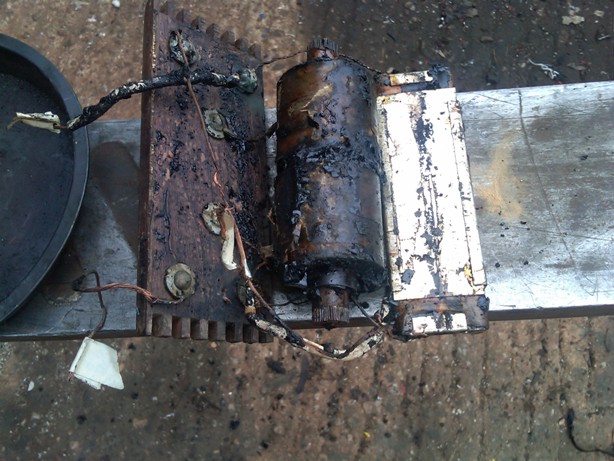
Here's what you'll find inside.
George IVy
 |
david scott
New member
Username: froggy
Post Number: 3
Registered: 07-2016
| | Posted on Saturday, July 30, 2016 - 04:37 am: |
|
Hi George, you have beaten me to it!
I could clearly hear it tracking inside the coil area after excavating the condenser area. There is perished insulation on the wire sitting above the condenser, an easy fix, but opening up the coil area, as little as possible obviously, revealed the wire which is wound around the coil and tied off in a knot was tracking against the terminal, turn it away and it works fine, nice fat spark, no arcing at the points.
Now I can see as it has never been insulated it appears to have no connective purpose, my thinking is to re-insulate that wire in the condenser area, snip the excess wire off at the coil and run it in the lathe, with the cap on and four plugs firing, as a soak test for an hour and see what happens? Any suggestions? I am reluctant to poke around more than necessary?
Quite how this came about is a mystery, I'd swear that hasn't been touched in a century but the pitch was quite fissured over the coil so maybe it created an opportunity for that wire to bridge to the terminal? Who knows?
popjpeg{272697,} |
david scott
Member
Username: froggy
Post Number: 4
Registered: 07-2016
| | Posted on Saturday, July 30, 2016 - 01:14 pm: |
|
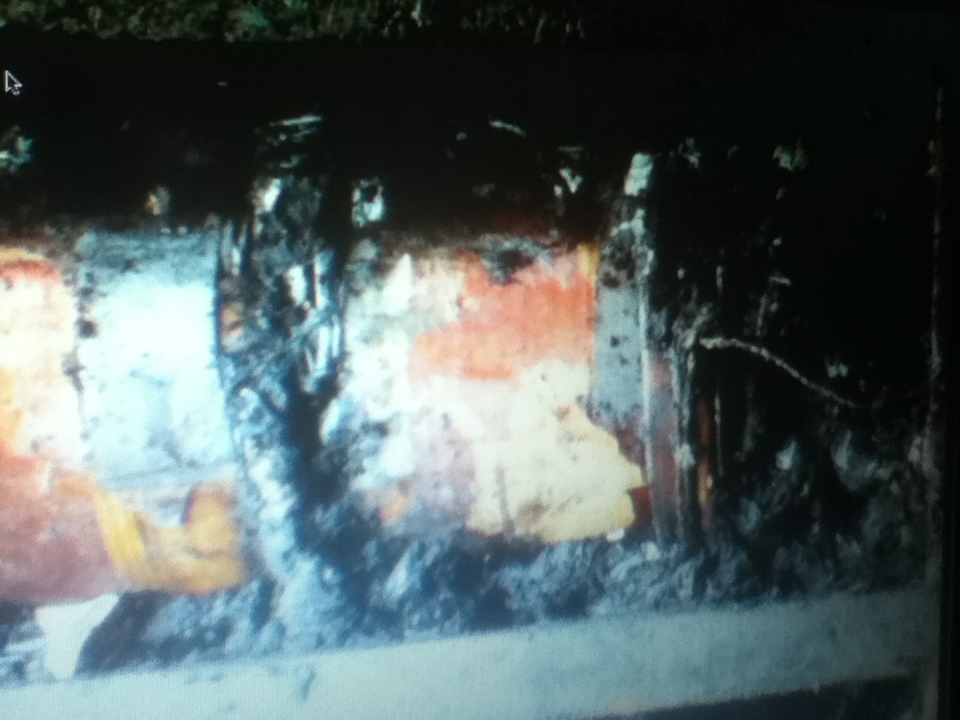
I'm struggling to get a file under 200kb but here is the best I can do:
 |
George Coates III
Member
Username: giii
Post Number: 15
Registered: 04-2010
| | Posted on Saturday, July 30, 2016 - 06:09 pm: |
|
In the one we took apart the tar was quite cracked as well. Was from shrinkage due to loss of volatiles over the years I believe. Also there was not a speck of insulation on any of the wires! Some of them quite close to other bits and pieces, too. I reassembled it with insulating paper between most of the wires and posts. I left the bad cap inside but disconnected it and buried the orange drop in the goo. Works very well. Hope that your repair is equally successful.
George the older |
Robert
Senior Member
Username: robert
Post Number: 723
Registered: 07-2003
| | Posted on Monday, August 01, 2016 - 11:28 am: |
|
Very informative gentlemen!
David, is your distributor a Type H or an earlier model?
Dick's comment above probably bears repeating: "Avoid sparking the coil without a spark gap load to control the upper voltage damaging the coil." |
david scott
Member
Username: froggy
Post Number: 6
Registered: 07-2016
| | Posted on Monday, August 01, 2016 - 12:00 pm: |
|
Hi George,
Mine is a K-2 Unisparker, and the box is the "plain wrapper" underhood version. I have tinkered with it, bending the errant wire away from anything ( but then why does it seem to have a high voltage if it's only a securing wire, and why if it's an HT wire is it not insulated? ) I feel the answers are not to be found without probably destroying the coil, so I'll leave it undisturbed apart from sealing the coil back over with Sikaflex.
It seems to give a good spark, anything up to 2" long as reported, and what I need is to get the car running. Then I will find out what other lies the PO has told me!! |
Robert
Senior Member
Username: robert
Post Number: 724
Registered: 07-2003
| | Posted on Wednesday, August 03, 2016 - 10:56 am: |
|
I see most of the answers are in Richard Durgee's post of June 19th, 2006.
It says any of the coils shown there can be used with the Type H or Type K2 distributors. |
david scott
Member
Username: froggy
Post Number: 7
Registered: 07-2016
| | Posted on Saturday, August 27, 2016 - 09:55 am: |
|
Update on my Unisparker, having disinterred both coil and capacitor sufficiently to see any problem, I discovered that the spark died away to nothing after a few strong sparks. Electrics not being my metier, I thought it over and came to the conclusion that the capacitor was at fault as when the spark died away, the "points" arced heavily. Somewhat in a "Heath Robinson " fashion (probably meaningless to anyone not English ??) I just bought several 220uf capacitors, for an Austin Seven I think, and kept adding and subtracting capacitors until it seemed to produce a good spark with no arcing!
Just had it running for the frst time, very easy starter, first swing usually and now I have made a new float for the (also obscure) Mayer carb, I have had it running quite happily.
Thanks to all for their help with this problem, I might even have it running for the Light Car Driving Tests next month!
David Scott |
Ernie
Senior Member
Username: ernie
Post Number: 2314
Registered: 01-2002
| | Posted on Saturday, August 27, 2016 - 05:46 pm: |
|
David glad you figured it out.
I use Orange Drop caps at about .22K at 600V or a reasonable facsimile there of. I put the cap right in the Atwater Kent across the points and take the cap out of the coil.
http://www.ebay.com/itm/Sprague-Orange-Drop-715P-film-and-foil-022uf-600V-capaci tors-radial-leads-/322070303856?hash=item4afce2d470:g:vQsAAOSw0QFXCtzH
http://www.mouser.com/ProductDetail/Cornell-Dubilier-CDE/150223J630DB/?qs=sGAEpi MZZMv1cc3ydrPrF9O2k7r3G2yZoaXPpo1NEhE%3d |
Robert
Senior Member
Username: robert
Post Number: 736
Registered: 07-2003
| | Posted on Sunday, August 28, 2016 - 05:17 pm: |
|
Heath Robinson: Rube Goldberg's first cousin by marriage. Sounds like electronics is more your metier than you thought. Better call her the "Anglo-Saxon" for now on! ;-) |

 Atwater-Kent distributor cap


